---
title: "Planning your first collection"
description: "Choose which pieces to make, how they work together and which fabrics suit them."
url: "https://surajmalstudio.com/guides/planning-a-first-range"
---
# Planning your first collection
4 min read Planning your collection Updated 12 Sept 2026
Choose which pieces to make, how they work together and which fabrics suit them.
## Quick answers from this guide
### How do I choose the pieces for a first collection?
Start with the customer and the occasion. Give each piece a useful role, then check whether you can develop, explain and support the collection. There is no fixed number of styles every brand needs.
### What do Core, Statement and Companion mean?
A Core piece supports regular wear, a Statement piece makes the brand recognisable, and a Companion helps the others work as an outfit. These are planning tools, not a required formula.
### How should I plan colours and shared fabrics?
List each style, its colours, intended sizes and proposed fabric. Check how the pieces work together, then confirm fabric suitability, minimum orders and the extra stock each colour creates.
Each piece has a job in the collection An illustrative example
Everyday top Core
Statement jacket Statement
Companion trouser Companion
- CoreSupports regular wear through useful fit and comfort.
- StatementShows the brand through a distinctive shape, fabric or detail.
- CompanionHelps the other pieces work as an outfit.
Core · Statement · Companion
## 01Start with the customer and the occasion
Your first collection needs a clear reason to exist. Decide who the clothes are for, when they will be worn and what makes them worth choosing. This gives you a way to decide which designs belong together.
For example, a collection for a working day that ends with dinner could include an easy shirt, a trouser and a light jacket. The pieces need to work together in those settings. A garment for a completely different occasion can wait for another collection.
Write down the intended customer, use and selling price before refining individual designs. There is no fixed number of pieces every first collection needs. Choose a number you can develop, explain and support well.
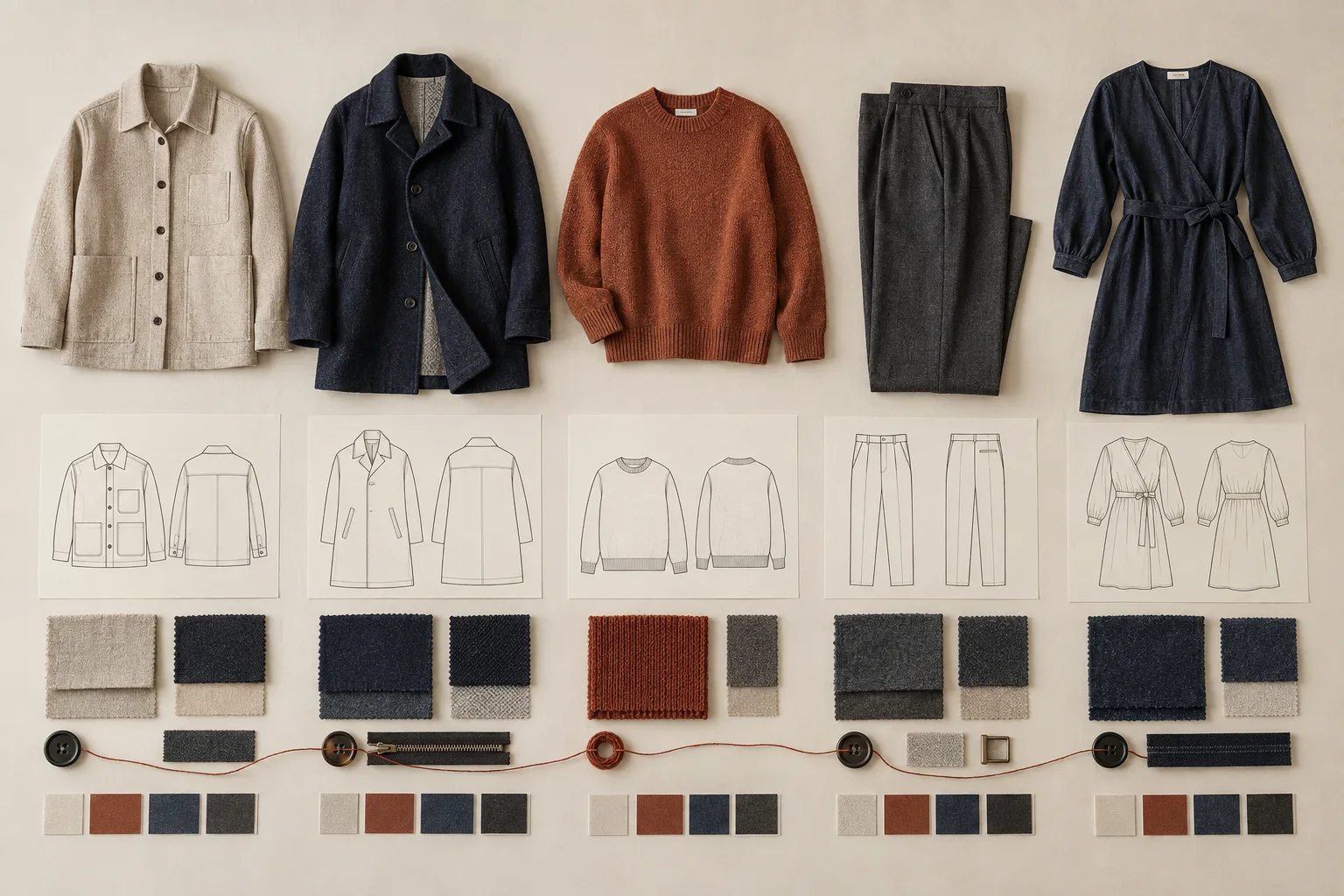
Five products shown with their drawings, fabrics, trims and colours. Each product has a purpose, while shared choices make them feel like one collection.
## 02Give each piece a reason to exist
These three roles can help you review a collection. They describe what a piece contributes; every collection does not need the same mix.
### Core
The piece someone can wear often. An everyday top might carry the fit and comfort people return for.
### Statement
The piece that makes the brand most recognisable. A jacket might show its distinctive shape, fabric or detail.
### Companion
The piece that helps the others work as an outfit. A trouser might balance the jacket and work with the everyday top.
Ask what would be lost if you removed a piece. Does it serve a different use, complete an outfit or offer a needed fit? If another piece already does the same job, consider whether both need to launch together.
What changes when you remove a piece? 5 styles · 6 functions
Switch a style off and read what the range stops doing. If nothing changes, review whether both pieces need to launch together.
- Everyday top Core Repeat wear · Colour continuity
- Second everyday top Core Repeat wear
- Statement jacket Statement Recognition · Distinctive fabric
- Companion trouser Companion Outfit completion · Balanced outfit
- Knitted accessory Companion Colour continuity
Nothing removed yet
Switch one off. The interesting styles are the ones the range does not miss.
Illustrative collection: removing a piece shows which jobs the remaining clothes still do.
## 03Plan the pieces and colours together
Make a simple collection plan with a row for each style. Include its role, colours, intended sizes, proposed fabric and the pieces it can be worn with. A colourway means a version of the same design in a particular colour.
Look across the plan before approving each garment separately. Do the lengths and shapes work together? Can the customer make useful outfits? Do shared colours connect the pieces without making them all identical?
### A colour decision you can check
An everyday top and companion trouser in the same neutral can form a set. A second colour for the top may offer another outfit. Before adding it, check the fabric minimum and the extra stock it creates across sizes.
Shared fabric or fastenings can reduce some purchasing and development work, but they still need to suit each garment. A soft fabric that works for the top may not give the jacket enough structure.
Keep a piece when it adds something useful to the collection. Its role should be clear enough to explain in a sentence.
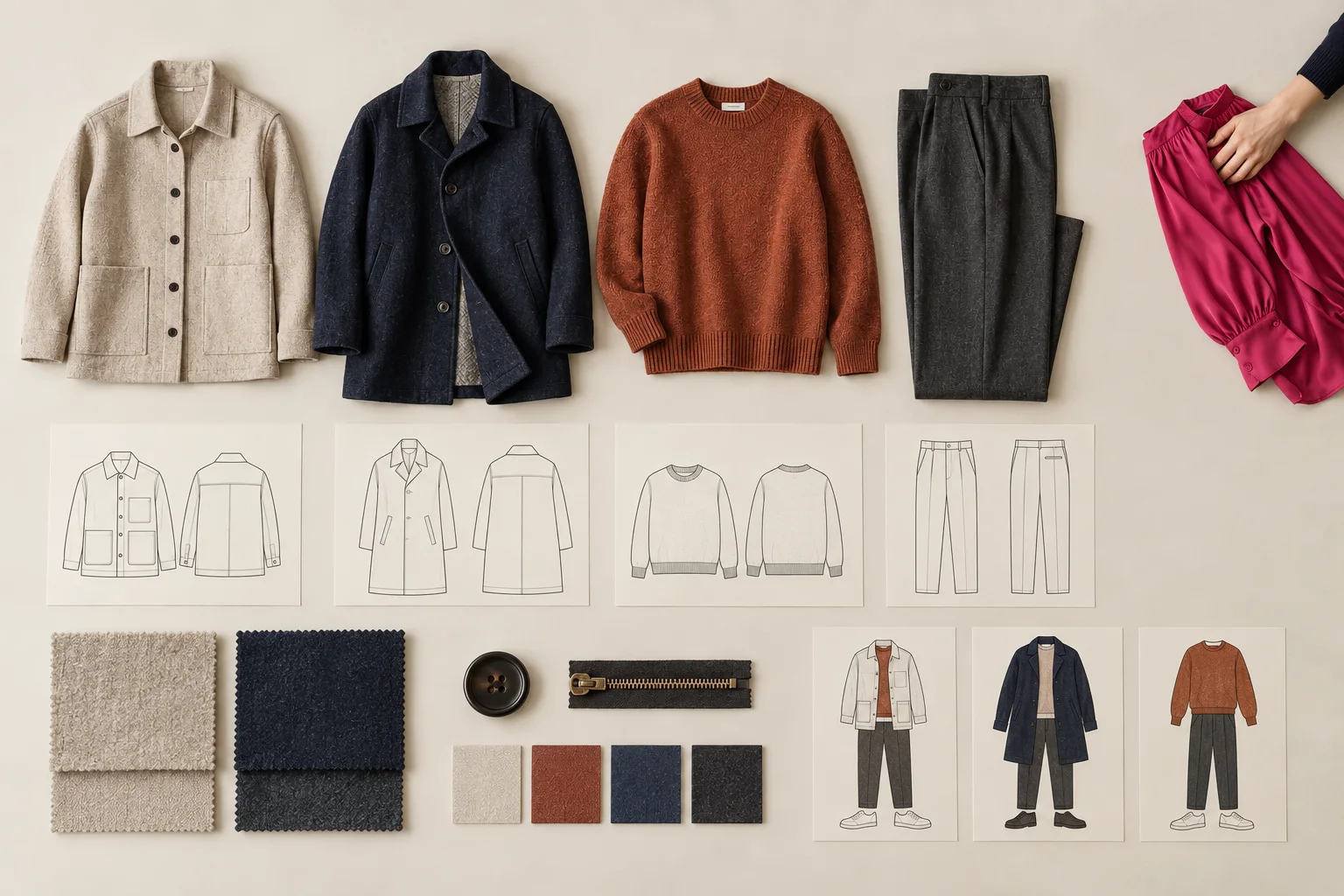
Four products work clearly together after an unrelated fifth product is removed. The common materials, colours and outfit combinations are easier to see.
## 04Choose fabric for how the clothes will be used
Start with what the garment needs to do. Think about movement, climate, coverage, the feel against the skin and how the customer will care for it. The right fabric for a close-fitting exercise top may be quite different from the right fabric for a relaxed outer layer.
Describe the shape you want too. Should the fabric hold a clean line or fall softly? Does it need to stretch and recover? These questions help the designer and supplier suggest suitable options.
Separate essential needs from preferences. Colour and appearance matter, but a fabric also has to work when the garment is worn and cared for. Our [fabric-selection guide](https://surajmalstudio.com/guides/choosing-fabric-for-a-first-collection) takes this further.
## 05Compare a short list of fabrics
- Compare how each fabric behaves in the intended use and shape.
- Check weight, construction, stretch and feel with the supplier.
- Ask about availability, colours, minimum orders and delivery timing.
- Check whether shared fabric works for every piece that uses it.
- Use samples and relevant tests to resolve questions a swatch cannot answer.
A swatch helps you narrow the choice. A garment sample shows more about fit, seams and movement. Keep a record of the fabric reference and finish being reviewed, so later samples can be compared fairly.
## 06Check the plan before production
Before ordering stock, confirm the approved styles, colours, materials and quantities. The making instructions and samples should describe the same collection. Record any agreed change with its effect on fit, cost and timing.
If a fabric becomes unavailable, review the substitute in the garments it affects. Check how it changes the shape, making process and finished appearance before approving it.
Bring the collection plan into the [development-cost discussion](https://surajmalstudio.com/guides/what-drives-development-cost). It helps the team identify what can be shared, what needs separate work and which decisions should be settled next.
[Subscribe to new guides on the website.](https://surajmalstudio.com/guides/planning-a-first-range)
Working on a range
Get help turning the next decision into a practical plan.
[Talk about your idea](https://surajmalstudio.com/enquire)
## Read next
### [Choosing fabric for a first collection](https://surajmalstudio.com/guides/choosing-fabric-for-a-first-collection)
Choose fabric before finalising the styles because its structure and finish determine how the clothes hang, which maker can sew them, and the quantities and costs involved.
### [What affects design and sampling costs?](https://surajmalstudio.com/guides/what-drives-development-cost)
Understand what you pay for before production, what can be shared and how to plan the work for your first collection.
### [From a sketch to the first real sample](https://surajmalstudio.com/guides/from-sketch-to-first-sample)
How a drawing becomes a garment, what the first sample can prove, and which written approvals carry the clothes through to production.
### [How long does it take to get a clothing range made?](https://surajmalstudio.com/guides/how-long-to-make-a-clothing-range)
The time to make a clothing range depends on fabric, sample approvals and the maker’s available time; a delivery date needs those steps worked out.
Read next [Choosing fabric for a first collection 7 min read · Planning your collection](https://surajmalstudio.com/guides/choosing-fabric-for-a-first-collection) [What affects design and sampling costs? 5 min read · Costs, orders and delivery](https://surajmalstudio.com/guides/what-drives-development-cost) [From a sketch to the first real sample 7 min read · Developing your product](https://surajmalstudio.com/guides/from-sketch-to-first-sample) [How long does it take to get a clothing range made? 4 min read · Planning your collection](https://surajmalstudio.com/guides/how-long-to-make-a-clothing-range)
---
[View this page on the website](https://surajmalstudio.com/guides/planning-a-first-range)