---
title: "How to read a garment sample"
description: "Feedback becomes actionable when each sample is judged against its specification and current decision."
url: "https://surajmalstudio.com/insights/2026/06/how-to-read-a-garment-sample"
---
# How to read a garment sample
4 min read Developing your product Published 8 Jun 2026
Feedback becomes actionable when each sample is judged against its specification and current decision.
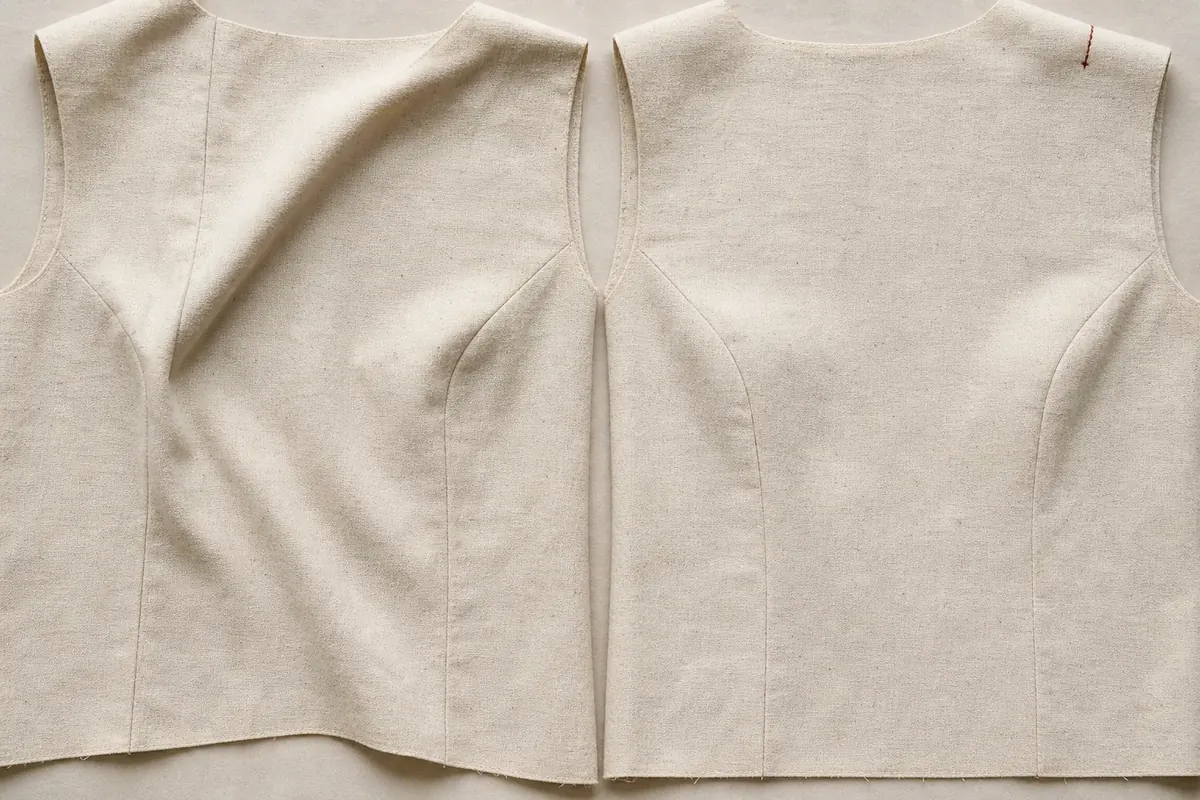
Illustration: diagonal folds and different hem levels across two fronts. Note the visible differences, then check fit on the intended wearer.
## 01Name the question this sample should answer
Read a garment sample as evidence about a specification, not as an unfinished version of the shop garment. Its job is to show how the current decisions behave when they become physical. The useful review asks what the sample can prove, where it departs from intent and what instruction would change the next version.
Begin by naming the question this sample carries. An early form may be testing silhouette, proportion and the relationship between parts. A later review may test fit, material behaviour or whether approved decisions now coexist. Judging every quality at once gives equal weight to evidence that is present, provisional or absent.
The same comment, twice 5 rewrites
Left costs a sample round. Right changes the next one. The difference is never politeness, it is whether the maker can act without guessing.
1. “The fit is a bit off” Half chest is 2cm over the spec at the base size. Take it from the side seam, not the armhole.
2. “Make it feel more premium” Move to a heavier weight in the same construction, and take the neck rib to a finer gauge.
3. “The colour is not right” Approve against the lab dip under D65, not the screen. Bulk should match the sealed dip.
4. “The sleeve looks wrong” Sleeve length is correct; the armhole is sitting low. Raise it and keep the length as sealed.
5. “Can we make it a bit shorter” Take 1.5cm off body length at the base size and hold the grade rule as it is.
Every comment on the left is missing one specific thing.
5 rewrites · each right-hand comment names a measurement, a reference or a direction
## 02Compare the garment with its instructions
Place the specification beside the garment. The specification includes the drawing, measurements, construction notes, material direction, approved references and the recorded intent behind them. Compare the sample with that record before comparing it with an imagined finished piece. Otherwise a convincing accident can be approved and an intentional provisional feature can be rejected for looking incomplete.
Read from whole to part. Look at balance, silhouette and proportion on the body. Observe where the garment sits at rest, then what changes during movement. A hem that appears uneven may be reporting an issue higher in the garment. A sleeve that feels narrow may be affected by the armhole or shoulder. Starting with the visible symptom can prescribe a local change to a connected problem.
Separate observation from diagnosis. “The front lifts when the arms move” is an observation. “Add length to the front” is a proposed solution. Recording the observation first preserves useful evidence and gives the pattern specialist room to identify the cause. If the founder owns a design outcome rather than the technical method, the comment should make that ownership clear.
Replace feelings with relationships. “It looks awkward” does not tell the next sample what to change. “The pocket sits too close to the opening and interrupts the clean front” identifies the element, its relationship and the intended quality. “The collar feels severe” can become “reduce the visual height while keeping enough structure to frame the neckline”. The feeling remains useful once translated into a condition.
## 03Write comments the maker can act on
A strong comment contains a location, an observed difference, the intended result and the evidence used to judge it. Mark the point on a photograph or drawing where necessary. Refer to the named measurement, construction note or approved reference. State what must remain unchanged so a correction does not solve one issue by disturbing another.
Material comments need the same precision. Touch, drape, opacity, recovery and surface are distinct qualities. “Use a better fabric” collapses them into status. Say which behaviour fails the product promise: the cloth holds away from the body when the silhouette needs to fall, the surface catches light in a way that competes with the form, or the material does not recover after movement.
Treat placeholder elements as placeholders. Colour, buttons or labels may be wrong because they are not the question being tested. Record that they are not approved, then keep them from dominating the review. Conversely, a provisional material may make a fit judgement unreliable if its behaviour is too different from the intended one. Name that limit instead of borrowing certainty from the sample.
Review under conditions that reveal the question. Use the body, movement, fastening and layers the garment was designed around. A still inspection can conceal balance and access problems, while an improvised styling combination can make the sample answer for a use it was never meant to serve. Record the review context with the comment so the next version can be read against comparable evidence.
## 04Agree what changes before the next sample
Comments need hierarchy. Identify issues that challenge the product idea, followed by those that affect fit or use, then those concerning finish and expression. This order does not diminish detail. It prevents careful refinement from making an unresolved shape look settled. A later decision should not conceal an earlier question.
Resolve conflicting comments through the product promise. A request for a closer fit and another for easier movement may both be reasonable, but they cannot simply be added together. Return to the intended relationship between body and garment, then decide which outcome governs. The specification should record that decision so the same debate does not return with the next sample.
End the review with explicit decisions; [our sampling guide sets out the approval stages](https://surajmalstudio.com/guides/from-pattern-to-approved-sample). State what is approved, what changes, what remains open and what evidence the next sample must provide. Avoid a general approval followed by a long comment list. Approval should attach to named features, because the next version needs a stable reference as much as it needs corrections.
Preserve a change trail between reviews. Carry forward the approved reference, the requested change and the reason for it, then check the new sample against all of them. This distinguishes a correction that has not been made from one that was made but produced another effect. It also prevents an old preference from returning as though the previous decision never happened.
The next sample improves when every comment tells it which decision to carry more faithfully.
Your next step
Put this into practice for your collection.
[Talk about your idea](https://surajmalstudio.com/enquire)
## Read next
### [From a sketch to the first real sample](https://surajmalstudio.com/guides/from-sketch-to-first-sample)
How a drawing becomes a garment, what the first sample can prove, and which written approvals carry the clothes through to production.
### [From pattern to approved sample](https://surajmalstudio.com/guides/from-pattern-to-approved-sample)
Treat the base pattern, fit approval, grade rule, size set and production sample as one connected sequence of decisions.
### [What is the sample that production gets checked against?](https://surajmalstudio.com/guides/what-is-a-sealed-sample)
The approved sample fixes what the maker must reproduce, with written measurements and decisions supporting checks before production, during making and before delivery.
### [What to check in your first clothing sample](https://surajmalstudio.com/insights/2026/07/first-sample-is-never-the-product)
Use the first sample to check shape, fit, fabric and making details, then give the next round a clear brief.
Read next [From a sketch to the first real sample 7 min read · Developing your product](https://surajmalstudio.com/guides/from-sketch-to-first-sample) [From pattern to approved sample 9 min read · Developing your product](https://surajmalstudio.com/guides/from-pattern-to-approved-sample) [What is the sample that production gets checked against? 4 min read · Developing your product](https://surajmalstudio.com/guides/what-is-a-sealed-sample) [What to check in your first clothing sample 3 min read · Developing your product](https://surajmalstudio.com/insights/2026/07/first-sample-is-never-the-product)
---
[View this page on the website](https://surajmalstudio.com/insights/2026/06/how-to-read-a-garment-sample)