---
title: "Against the mood board"
description: "A reference wall records what you are attracted to. That is not a direction."
url: "https://surajmalstudio.com/insights/2026/07/against-the-mood-board"
---
# Against the mood board
4 min read Brand identity Published 29 Jul 2026
A reference wall records what you are attracted to. That is not a direction.
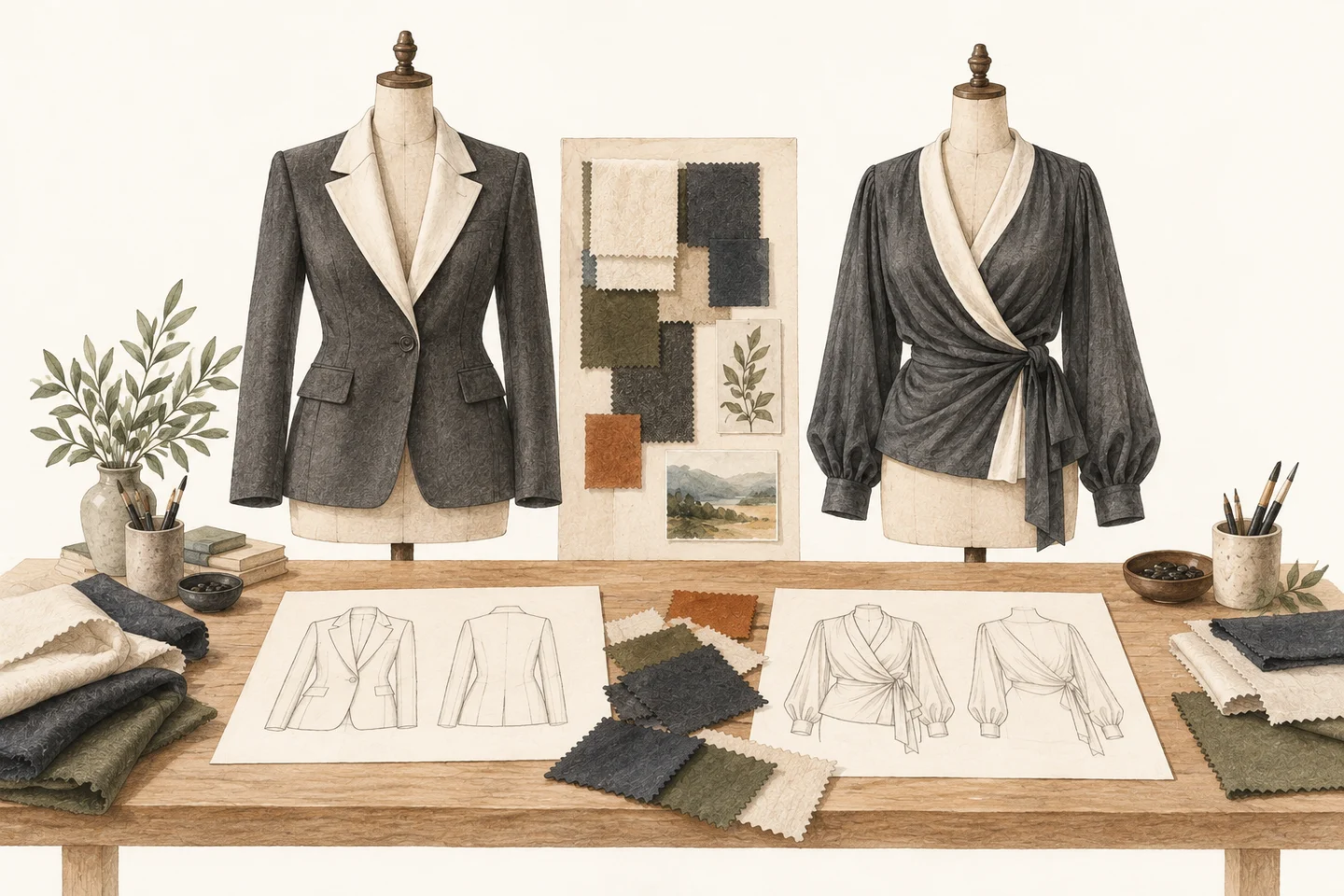
Studio illustration: one fabric palette, two different garments. A structured jacket and a draped wrap blouse need different silhouette and construction decisions.
## 01What a mood board can tell you
A mood board is evidence of taste, not a brand direction. If it is allowed to make decisions, the work will become an average of things that already exist.
References still have a proper use. They let a founder and a designer establish a shared visual vocabulary quickly: spare or decorative, crisp or washed, tailored or loose. They can show the intended hand feel, meaning the tactile character of a fabric, more clearly than an adjective can. Trouble starts when the board is asked to answer questions it contains no information about. It cannot say why a silhouette belongs to this brand, whether the product earns its retail position, or which recognisable feature should survive when cost and construction become difficult.
Selection has no consequence when every image begins approved. Contradictions are easy to hide: one reference supplies the colour, another the typography, another the garment volume, and a different one the photographic mood. The resulting collection may look coherent on a wall because the crops and colours have been curated. Once those fragments become a logo, a product page, a woven label and a real garment, the missing logic shows.
01
### A reference wall cannot be wrong, which is why it cannot be a direction.
What it rests on
Every image on a mood board was chosen because someone already liked it, so the board has no failure state. Nothing on it can be contradicted by the next image added. A direction states what the brand refuses, and that refusal is checkable against any piece of work you put beside it.
What would change it
A board that included things the brand will not do, marked as such, and was used to reject work rather than to approve it. That board would be arguable, and we would be wrong about this.
Only a direction can be tested 2 inputs
The useful difference is not inspiration. It is whether the input can reject a direction.
### A reference wall
No test
Establishes a shared visual reference.
Nothing on it can be wrong.
### Three sentences
Testable
States what the brand is for, who it competes with and what it refuses.
The direction can fail, so it can be tested.
2 inputs · 1 creates a failure state
A direction can fail, which makes it testable.
## 02Turn references into design decisions
A direction has to exclude. It should state what the brand is for, the situation in which it matters, the alternatives against which it will be judged, and what it refuses to become. Refusal is the useful part because it creates a failure state. If a proposed typeface feels polished but the direction calls for plain-spoken utility, it can be rejected for a reason. If a pocket detail looks attractive but turns a quiet garment into equipment costume, the same rule applies. Taste begins the conversation; a direction settles it.
## 03An example: clothes for work and evening
Consider a collection intended for people who move between a formal workplace and a less formal evening without changing clothes. The reference wall might contain faded work jackets, fine shirting, restrained editorial layouts and polished metal details. Taken literally, those ingredients pull apart. The jackets suggest weight and visible construction. The shirting suggests lightness and close finishing. The metal adds a degree of display that the layouts seem to resist.
The productive step is to translate attraction into rules. The garments need enough structure to hold their line through a working day, but no overt workwear signals. Fabric can therefore be chosen by drape, the way it falls under its own weight, and recovery after wear, not by resemblance to a reference jacket. A restrained palette may remain, while contrast stitching and oversized hardware are refused. The identity can use the same discipline: clear hierarchy, little ornament, and language grounded in use.
That translation changes development. A fabric proposal can now be judged against behaviour. Its gsm, or grams per square metre, indicates weight but does not settle whether it feels dry, fluid or compact, so a physical swatch still matters. A proto, the early sample used to test shape and construction, can be read for whether the shoulder and body create the intended ease. A lab dip, the supplier's small dyed colour submission, can be approved against the palette in the material that will carry it. Each decision has a reason beyond resemblance.
The same discipline protects the digital work. A homepage does not need to copy the cropping, motion or type treatment of the sites on the board. It needs to make the same position legible at a different scale. Product names, navigation and image order should help a customer understand the clothes. When a visual gesture competes with that task, the direction tells us which one loses.
## 04Write a brief others can use
References also need their sources separated. A campaign image can be useful for light, casting or attitude while being irrelevant to garment design. A vintage piece may contribute a pocket proportion without licensing its fabric, colour or cultural meaning. Label each reference with the decision it is allowed to inform. Otherwise the most visually forceful image begins controlling decisions that were never examined.
This matters when people join the work later. A photographer, pattern cutter and digital designer will each read the same board through their own discipline. The photographer sees composition. The pattern cutter sees shape and construction. The digital designer sees colour and hierarchy. Written rules keep those readings connected. They also make review less personal: feedback can return to an agreed principle instead of becoming a contest between preferences.
Before design begins, write a short statement that can be disagreed with. Name the customer by a real situation, not a broad demographic. Name the established choices the brand will sit beside. Record the materials, silhouettes and signals that are out of bounds. Then test the mood board against those words. Remove any reference that is attractive but irrelevant, and annotate the ones that remain with the specific lesson they carry.
Bring the mood board. Just do not ask it to have a point of view on your behalf.
Your next step
Put this into practice for your collection.
[Talk about your idea](https://surajmalstudio.com/enquire)
## Read next
### [How to write a brand identity brief](https://surajmalstudio.com/insights/2026/06/writing-a-brand-identity-brief)
Tell your designer who the brand is for, how you want it to feel and where the design will be used.
### [Positioning against an incumbent with no history](https://surajmalstudio.com/insights/2026/06/positioning-without-history)
Without a history to claim, a brand's defensible position is the product choice visible on launch day.
### [A visual system that survives contact with a garment](https://surajmalstudio.com/insights/2026/06/a-visual-system-that-survives-a-garment)
Labels, tags, cartons and shopfronts reveal whether the identity is a system or only a screen presentation.
### [Naming a clothing brand](https://surajmalstudio.com/insights/2026/06/naming-a-clothing-brand)
Speech, search, ownership and garment application decide whether a clothing brand name works.
Read next [How to write a brand identity brief 2 min read · Brand identity](https://surajmalstudio.com/insights/2026/06/writing-a-brand-identity-brief) [Positioning against an incumbent with no history 4 min read · Brand identity](https://surajmalstudio.com/insights/2026/06/positioning-without-history) [A visual system that survives contact with a garment 4 min read · Brand identity](https://surajmalstudio.com/insights/2026/06/a-visual-system-that-survives-a-garment) [Naming a clothing brand 4 min read · Brand identity](https://surajmalstudio.com/insights/2026/06/naming-a-clothing-brand)
---
[View this page on the website](https://surajmalstudio.com/insights/2026/07/against-the-mood-board)