---
title: "The second order is the real test"
description: "Anyone can get a first run made. Repeating it at the same quality is the harder thing."
url: "https://surajmalstudio.com/insights/2026/07/the-second-order-is-the-real-test"
---
# The second order is the real test
4 min read Working with manufacturers Published 11 Jul 2026
Anyone can get a first run made. Repeating it at the same quality is the harder thing.
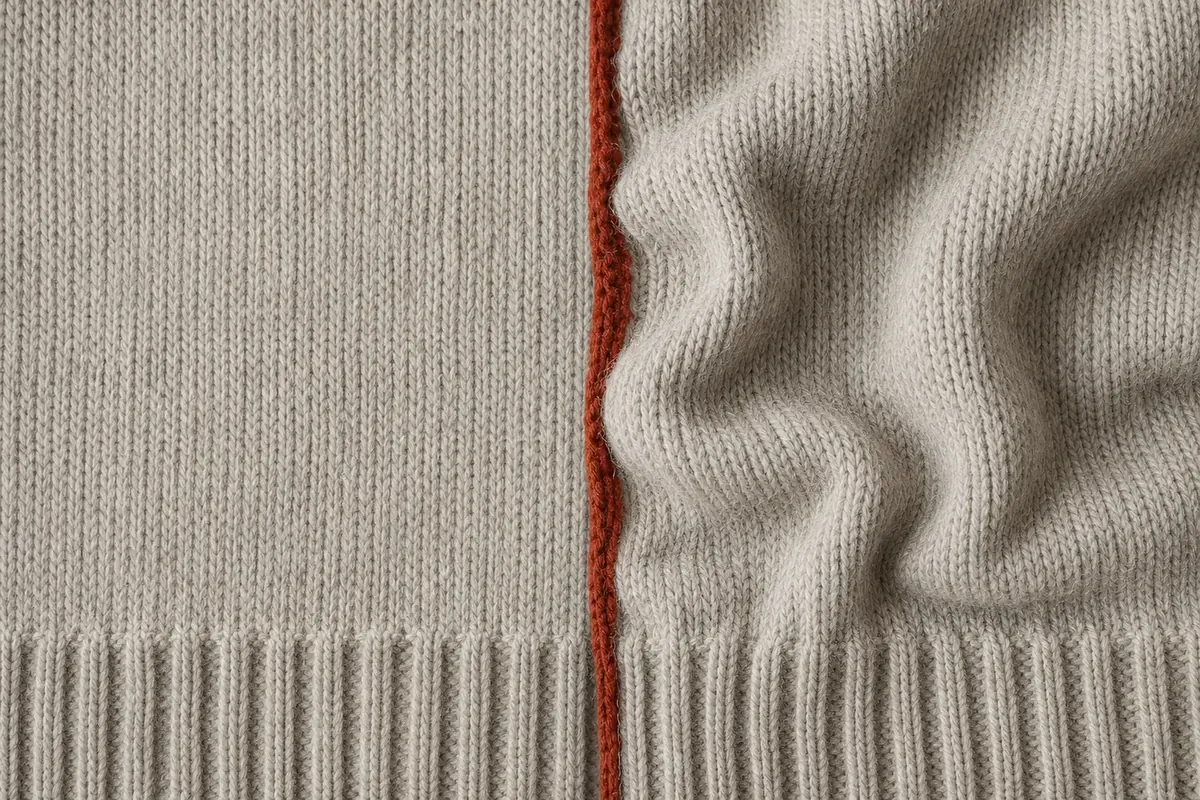
Illustration: a flatter rib join beside a rippled one. Compare each production run with the approved physical reference.
## 01What a repeat order needs
The first production run proves that a garment can be made once. The repeat proves whether the product exists as a controlled specification instead of a remembered achievement.
First runs receive concentrated attention because many decisions are still live. The pattern is discussed, sample comments are recent, and the approved garment is familiar to the people involved. That attention can carry missing information. On a repeat, fabric may come from another dye lot, meaning a batch dyed together, and production may involve different hands. Anything held only in memory becomes a new decision.
Locked records hold; memory drifts 4 repeat controls
A repeat holds when the approved state is recorded, not remembered.
The difference appears on reorder
### Fabric weight and shade
Locked record
Approved fabric standard, lab dip and bulk shade record
Informal substitute
A swatch and a verbal agreement
### Fit across the size set
Locked record
Graded points of measure with tolerances
Informal substitute
An approved sample and a good memory
### Trims and labels
Locked record
Named references and placements
Informal substitute
Whatever the last run used
### Finish and hand
Locked record
A sealed PP sample and approved finish standard
Informal substitute
Attention from the same operator
| Control | Locked record | Informal substitute |
| --- | --- | --- |
| Fabric weight and shade | Approved fabric standard, lab dip and bulk shade record | A swatch and a verbal agreement |
| Fit across the size set | Graded points of measure with tolerances | An approved sample and a good memory |
| Trims and labels | Named references and placements | Whatever the last run used |
| Finish and hand | A sealed PP sample and approved finish standard | Attention from the same operator |
4 controls · 4 locked records · 4 informal substitutes
A correct first delivery does not show whether repeat-order controls are in place.
## 02Record how the first garment was made
Repeatability begins with distinguishing an outcome from its cause. An approved sample records how one garment turned out. It does not automatically record the pattern version, fabric state, sewing method, wash conditions or measurement tolerance that produced it. If a pocket lies flat because an experienced operator adjusted the tension by eye, the sample preserves the flat pocket but not the instruction.
The technical record has to carry that instruction. Points of measure are the named locations used to check a garment, such as chest, body length and opening. Each target needs a tolerance, the acceptable variation around it. The grade rule states how those targets change between sizes. Together they protect the fit more reliably than a note saying “same as approved sample”, because they make drift observable.
Fabric needs comparable control. Gsm, or grams per square metre, records weight, but it does not fully describe hand feel, the tactile quality of a cloth, or drape, the way that cloth falls under its own weight. A retained swatch gives a tactile standard. A lab dip, the small dyed colour submission reviewed before fabric is committed, controls shade before bulk and should be tied to the approved colour reference. Colour fastness records how well the shade resists specified washing, rubbing or exposure conditions. Each control answers a different question.
## 03An example: a sweatshirt changes between orders
Imagine a loopback cotton sweatshirt whose first run has the intended compact body and clean rib hem. On repeat, the shell fabric meets the recorded gsm and the chest measures within tolerance, yet the garment feels longer and the hem ripples. The specification contains an approved sample and general fabric composition. It does not state the relaxed measurement after washing, the rib recovery or how the shell and rib should be conditioned before assembly.
Nobody needs to make a dramatic error for that garment to drift. A new dye lot can receive a slightly different finish. The rib can recover with a different force. Cutting can occur before the fabric has settled. Washing then changes the shell and rib at different rates. Every individual choice may look reasonable, while the worn result loses the compact line that defined the first run.
## 04Prepare the next order from clear references
The corrective action is not “match the original more carefully”. Record the material and process conditions that matter. Set the relevant measurements at the state in which they will be inspected. Establish shrinkage allowance, the pattern provision made for expected dimensional change. Name the rib quality and recovery standard. Keep construction details clear enough that a different operator can reach the same result without private instruction.
The pre-production sample is central. This is the signed garment made with approved fabric, trims, labels, construction and finish before bulk begins. It is a physical standard, not a substitute for the written one. When the sample and specification disagree, the discrepancy must be closed before production. Leaving both in circulation asks the production team to choose which approval was meant.
A useful repeat pack also records change. Pattern files need clear versions. Revised points of measure should not sit beside obsolete tables without status. Substituted thread, fusible or elastic must be reviewed for the effect it can have, even when the customer will never see the component. Quiet substitutions are a common route by which a product remains recognisable yet stops feeling the same.
Inspection should be designed around product risk. A loose body may absorb small variation at the chest while a narrow neck opening cannot. A printed placement may tolerate movement on an all-over motif but not when it must align with a pocket. The agreed checks should concentrate on the features that carry fit, function and recognition, then judge them against the approved standards.
Repeat orders also expose whether the bill of materials was specific enough. A generic entry such as “black elastic” permits several technically acceptable replacements with different recovery and surface. Naming the construction, dimensions, performance and approved reference turns a purchasing note into a product control. The customer may never see the elastic, but they will feel what it does.
Before placing a repeat, review the first run as evidence alongside [our guide to recording the decisions behind a specification](https://surajmalstudio.com/guides/what-to-decide-before-a-specification). Which variations appeared during inspection? Which comments were resolved through conversation but never entered in the file? Are the approved colour, fabric, trim and finish standards still available and clearly named? Does the grade still protect the silhouette across the size range? Close those gaps before asking production to recreate the result.
Craft can rescue one run. Only a specification can remember it.
Your next step
Put this into practice for your collection.
[Talk about your idea](https://surajmalstudio.com/enquire)
## Read next
### [Choose who buys the fabric and develops the clothes](https://surajmalstudio.com/guides/cmt-or-full-package-for-a-first-order)
Use the state of your first design to choose the work you need, then assign each material and approval.
### [How can a manufacturer be checked before sending money?](https://surajmalstudio.com/guides/how-do-i-know-a-manufacturer-is-real)
Check the business records, factory, sample and payment details together, with separate decisions before paying for a sample and before ordering the clothes.
### [Changing manufacturer without losing the product](https://surajmalstudio.com/guides/changing-manufacturer)
Keep the clothes consistent by transferring their approved records, settling access to patterns, and testing the new maker before moving the main order.
### [Choosing who makes the clothes](https://surajmalstudio.com/guides/choosing-a-manufacturer)
Choose a maker by checking relevant work, agreeing who handles each task, and comparing the same clothes, quantities and delivery plan.
Read next [Choose who buys the fabric and develops the clothes 3 min read · Working with manufacturers](https://surajmalstudio.com/guides/cmt-or-full-package-for-a-first-order) [How can a manufacturer be checked before sending money? 4 min read · Working with manufacturers](https://surajmalstudio.com/guides/how-do-i-know-a-manufacturer-is-real) [Changing manufacturer without losing the product 7 min read · Working with manufacturers](https://surajmalstudio.com/guides/changing-manufacturer) [Choosing who makes the clothes 7 min read · Working with manufacturers](https://surajmalstudio.com/guides/choosing-a-manufacturer)
---
[View this page on the website](https://surajmalstudio.com/insights/2026/07/the-second-order-is-the-real-test)