---
title: "Menswear is not womenswear with different measurements"
description: "The blocks differ, the grading follows different logic, and menswear trouser sizing multiplies the size count, so crossing between the two is a second development programme."
url: "https://surajmalstudio.com/insights/2026/08/menswear-is-not-womenswear-resized"
---
# Menswear is not womenswear with different measurements
15 min read Planning your collection Published 20 Aug 2026
The blocks differ, the grading follows different logic, and menswear trouser sizing multiplies the size count, so crossing between the two is a second development programme.
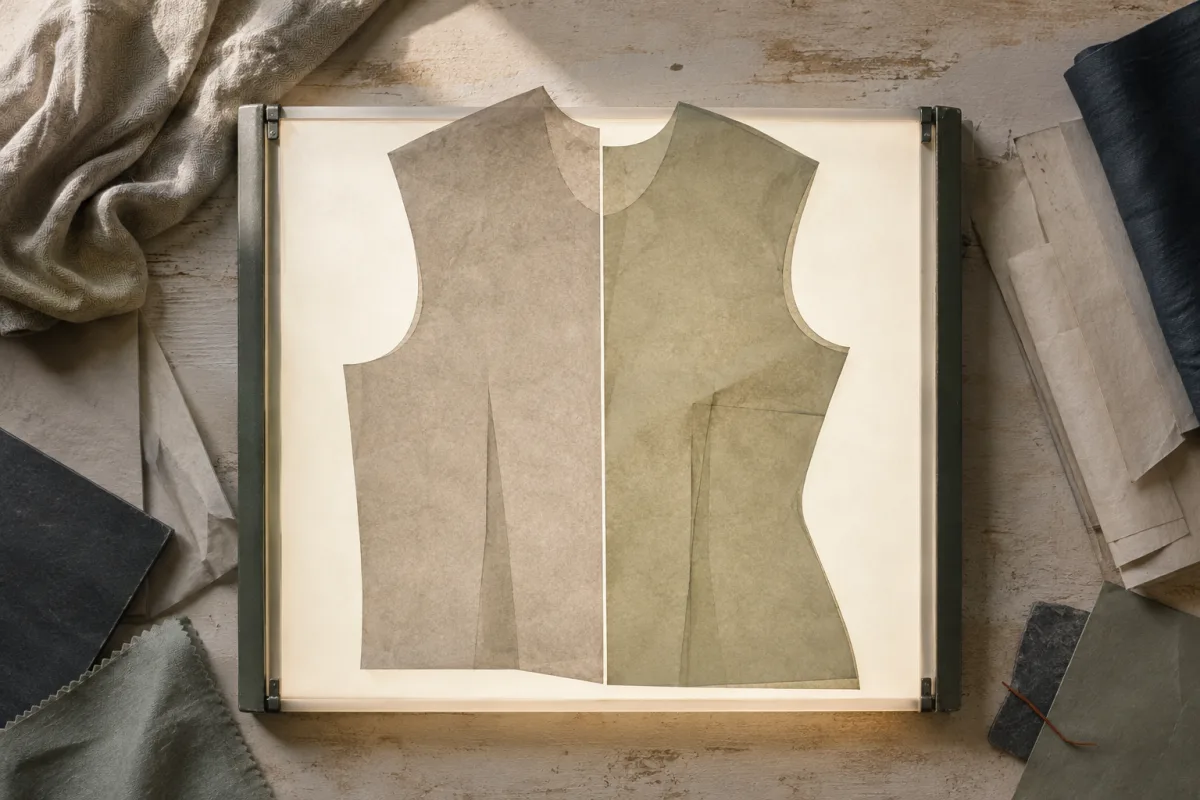
Illustration: two differently shaped body blocks aligned at the front. Define the intended body and fit; do not infer them from a category name.
A brand moving from womenswear into menswear, or the other way, is starting a second development programme and not adjusting the first one. The shapes the garments are drawn from differ, the rules for extending them across sizes differ, and in menswear trousers the number of sizes can multiply instead of extending.
The assumption that the work transfers is a reasonable one, because some of it does. A founder who has already made one category has a supplier who understands the brand, a way of running fit sessions, a specification format that has been argued into shape, a colour process and a customer who is listening. Those are process assets and they carry across intact. What does not carry is the garment itself, and the garment is where the money goes.
## 01A block is a record of a body, not a size that can be scaled
A block is not a garment and it is not a size. It is a flat record of a body: a set of curves and straight lines holding a measured torso at a chosen amount of ease, with the seams placed where that body wants them. Every style a brand makes is drawn off it, which is why a fault in a block is never a fault in one garment. It repeats across the range, and it repeats in the same direction every time, so the collection acquires a characteristic nobody chose and nobody can locate.
Conventional menswear and womenswear blocks often distribute shaping differently across the shoulder, upper back, chest, bust and waist. These are starting conventions, not two uniform body types: people vary within and across categories. Define the actual measurements, proportions and wearing needs of the intended customer, then prove the block on representative bodies. A category label cannot settle shoulder slope, posture or armhole balance for the person wearing the garment.
Back width is the second control and it stays invisible until the garment moves. The distance across the upper back, taken against the chest measurement, decides whether the wearer can reach forward without dragging the whole garment with them. The two blocks hold that relationship differently, and a pattern cut from the wrong one tends to produce a back that is narrow for its own front. On the hanger it looks correct. In use the sleeve pulls the body of the garment forward, the front rides up, and the fault gets written up as a sleeve problem, which sends the correction to the wrong part of the pattern and uses a round of sampling to discover it.
The armhole is where the difference is hardest to disguise. Its depth, its width and the shape of the curve at the front and at the back decide how the sleeve is set and how much of the arm’s movement the garment absorbs rather than resists. Armhole depth, width and sleeve shape must be tested together. A deeper armhole can reduce reach by lifting the body of the garment, while a higher armhole still needs enough room and a compatible sleeve to move comfortably. The two blocks are not the same curve at different scales, because the front and back halves are balanced against each other differently: what sits in front of that armhole is built differently in the two bodies. A sleeve drafted to one armhole and set into the other twists, and the twist shows at the elbow rather than at the shoulder where it was made.
## 02Removing shaping does not convert a pattern, it takes the structure out
The relationship between chest and waist is the sharper difference. A womenswear block treats bust, waist and hip as three controls that move semi-independently, and the shaping between them, through darts, a princess seam or the curve of the side seam, is a large part of what the garment does. A menswear block is more often led by the chest, with the waist following from a conventional relationship between the two. Remove the bust shaping from a womenswear pattern and the result is not a menswear pattern. It is a womenswear pattern with the structure taken out, and it hangs like one.
In tailoring, drop describes a stated difference between chest and waist dimensions. Check whether a supplier is using body or garment measurements and which sizing convention applies. A chosen drop can help organise the offer, but it cannot guarantee that a jacket selected by chest alone fits at the waist. Both menswear and womenswear need their own measurement evidence rather than an assumed relationship between two numbers.
Shaping is also a quantity, and quantities have to go somewhere. The amount taken out of a womenswear pattern between the fullest part of the bust and the waist is a measurable thing, and the pattern maker decides where to spend it: into a bust dart, into waist darts, into a princess seam that carries it the length of the garment, or into the curve of the side seam. Each choice makes a different garment from identical measurements. Take the quantity out altogether and the seams that were holding it lose the reason they were curved, and what remains is a straighter garment still carrying a womenswear armhole, a womenswear shoulder and a back drafted for a different upper body.
The symptom is specific enough to be recognised. A converted pattern usually looks acceptable flat on the table, because flat is the condition it was drawn in. It fails on a body in two places at once, at the shoulder and at the waist, and the fit comments come back asking for the shoulder to be narrowed and the waist to be let out. Both comments are accurate and neither one is the fault. Correcting them as written walks the pattern through several rounds and lands it between the two blocks, which fits fewer people than either of them would have.
## 03Grading rules encode the way the body was described in the first place
Grading follows the same split. Grading is how an approved base size is extended across the rest of the size set, and the rules depend on how the body has been described in the first place. [Womenswear grading has to distribute increments across bust, waist and hip](https://surajmalstudio.com/guides/sizing-and-fit-for-womenswear) and decide how those three move against each other, because across a population they do not move together. Some grading systems derive several measurements from a leading dimension such as chest; others use separately specified increments. Neither method belongs exclusively to menswear or womenswear. A pattern room fluent in one set of rules will produce a technically clean grade in the other while still carrying assumptions that do not hold. The evidence appears at the ends of the size set first, where the derived measurements have drifted furthest from the size that was actually fitted.
The two logics are worth separating properly. A dimension led grade nominates one governing measurement, usually the chest, and derives the rest from it: back width grows by a set proportion of the chest increment, armhole depth by another, sleeve length by another again. It is quick, it is internally consistent, and it holds for as long as the population it describes really does grow in that proportion. A multi point grade treats bust, waist and hip as separate inputs and asks, at every size, how much of each to add and where to put it. It takes longer, it needs more decisions per size, and it produces a size set whose largest sizes are something other than the fitted size inflated.
What a founder sees is a returns pattern that is not flat across the size set. The middle sizes behave, the ends do not, and the comments cluster by direction: tight across the back at the top of the range, loose at the waist at the bottom. That is not a manufacturing fault and no tightening of tolerances will move it. It is the grade, and it is asking for the size set to be fitted at a second point instead of derived from one. The correction is cheaper than it sounds: one more fit sample per style family, taken near the end of the range where the drift is worst, so the rule gets corrected against a body rather than against itself.
## 04Two-number trouser sizing turns a size list into a grid
Then there is the trouser, which is where a plan built on the first category breaks quietly. Menswear trousers are frequently sold on two numbers, a waist and a leg length, chosen independently by the customer. That is a grid and not a list. Eight waists against three lengths is twenty four sizes for one style, where the same style offered on a single size number would have been eight. The consequence is felt twice. Sampling has to prove the length steps as well as the base fit, so the fitting programme grows. Stock is committed against every cell in the grid, in every colour, before a single customer has chosen anything. The cells fill unevenly, and the person who wants a common waist in an uncommon length is the one who finds nothing and does not come back.
Follow one style through. A founder has a single trouser, it sells, and the obvious next move is a second colour. On a single size number that is another eight lines. On a waist and length grid it is another twenty four, and every one of them is a unit that has to be ordered, received, counted, stored, listed as a selectable option and picked individually. Nothing about the design changed and no new development was done. The number of stock-keeping units tripled. The cash required depends on the planned depth and minimum quantity in each cell, which must be costed separately.
Sampling grows in a way that is less obvious than the stock does. The base fit is proved on the fitting size, but a length grid has to be proved as a set of steps, because a leg is a shaped thing and a shaped leg does not survive being shortened at the hem. The knee has to land where it was drawn to land at the shortest length and at the longest. The hem circumference has to be checked at each step, or the short option arrives reading wider than intended and the long one narrower. That is additional fittings on a style that has already been approved, which is exactly the moment a development calendar has stopped expecting them.
The reason this arrives late is structural rather than careless. The size grid is a merchandising decision wearing the clothes of a technical one, so it gets settled at the point the size chart is written for the supplier, which is after the design is fixed and often after the fit sample has been signed off. By then the range plan has been built on a count of styles, and the count of styles has quietly become a count of cells. The founder meets the difference at the buy, when there is no development time left to change the shape of the offer.
The decision that follows is not whether to offer lengths but where to offer them. Length options can be carried by the styles whose leg shape genuinely needs them and withheld from the ones cut loose enough not to care. Steps can be held down in the first season and widened where demand actually appears. A single leg cut long, with hemming offered as a service, converts a stock problem into a service problem, and a service can be extended or withdrawn without anything being bought. What does not work is [offering the whole grid in every colour on the first order](https://surajmalstudio.com/insights/2026/07/against-launching-with-everything), because the cells fill unevenly and the ones that do not sell were never a decision anybody consciously made.
## 05Fit names are chosen before the garment has been touched
Slim, regular, relaxed and tapered are useful fit names, but their meanings vary between brands in both menswear and womenswear. Give each name a consistent meaning within the range, backed by garment measurements and useful photographs. Repeat customers may rely on a remembered size and fit; first-time customers need enough information to compare the garment with what already works for them.
Self selection is worth following through, because it sets what a fit name has to be. A customer reordering from memory enters a waist, a length and a fit name, and does not open the photograph. That behaviour makes repeat purchase cheap to earn and makes inconsistency expensive to survive, because the customer who has stopped checking is the one most likely to be sent something wrong and the least likely to assume they caused it. A fit name in that setting is a promise made in advance of the garment.
Which means a fit name has to be a measurement rule and not a description. Slim has to stand for a stated relationship between thigh, knee and hem at a given waist, held across every style carrying the word, [written into the size chart](https://surajmalstudio.com/insights/2026/08/the-size-chart-is-a-brand-decision) and checked at sampling like any other measurement. Two trousers both called slim that differ by a noticeable amount at the knee have taught the customer to check again, and the second purchase then costs what the first one cost. In either category, publish the garment's measurements as well as the body chart where useful, with clear instructions about how each is measured. Do not assume that one group of customers measures and another does not.
## 06What crosses between the two categories, and in what order to spend it
Not every garment carries the full difference. A drawstring trouser, a boxy sweatshirt or an oversized shirt is designed to sit away from the body, and much of what separates the two blocks is held in the space the garment leaves. Fit led product carries all of it: a shirt with a fitted waist, a jacket, a tailored trouser, anything cut close through the torso. Deciding which of those the extension actually is settles how much development sits in front of it, and that decision is worth making before the first sketch rather than after the first sample comes back wrong.
The assets that do cross are worth naming precisely, because they are the reason the extension is worth doing at all. Construction knowledge crosses: how a collar is built so it stands, how a waistband is faced so it does not roll, how a seam is finished so it survives washing, none of that is category property. Cloth understanding crosses: what a weight and construction will do after wash, how much it grows on the bias, how evenly it takes colour, applies whatever is cut from it. Supplier relationships cross partially, and the qualification matters. The commercial relationship holds, the quality standard holds, the way a problem gets raised and settled holds, while the line that makes the existing product may not be the line that makes the new one. Asking a supplier to build something outside what they are set up to build is a reliable way to turn a good relationship into a poor first sample. The brand crosses completely, and it is the largest item on the list.
Costed honestly, a second category needs its own base block, [its own fit sessions on a fit model of that body](https://surajmalstudio.com/insights/2026/09/one-fit-model-is-not-a-fit-strategy), its own grade rules, its own size chart and its own set of approved specifications. It reuses the brand, the supplier, the palette, the cloth platform and the language, which is a genuine advantage and the reason extension is worth doing at all. It needs the pattern room to validate what can be reused.
The order those are bought in decides whether the money works. Settle first whether the extension is fit led or ease led, because that sets the size of the programme rather than its shape. Commission a base block for the new body instead of converting the existing one. Fit that block on a fit model of that body before a single style is drawn on it. Write a size chart for the new category rather than extending the old chart outwards. Then draw the range. Reversing any two of those produces the same outcome every time, which is a set of samples corrected individually, round by round, that never become a block and therefore never make the second style cheaper than the first.
## 07Brands that run both are the argument for the cost, not against it
The strongest objection is visible from any high street. A great many brands run menswear and womenswear together, under one identity, in one shop, often in the same cloth and on the same calendar, and they plainly are not behaving as though they run two development programmes. The answer is to look at what those brands actually spend on. They keep separate blocks. They fit on two fit models. They publish two size charts. In most cases the pattern makers work one side or the other and have done for years. What is unified is the brand, the buy, the cloth platform and the calendar. What is divided is the pattern room, which is precisely the division being argued for here. Running both categories is ordinary. Running both from one block is the thing that is not.
There is a real exception sitting inside that objection, and it explains why the practice looks cheaper than it is. Some brands genuinely do run close to one pattern logic across both, and they do it in product drawn to sit away from the body: a boxy tee, a drawstring trouser, an unstructured overshirt. It works because the ease is doing the fitting, and it stops working the moment anything in the range is cut close. A brand that begins there and later adds a shaped shirt or a tailored trouser has not extended its range. It has started the second programme it had until then been able to avoid, usually in the middle of a season that was planned on the assumption it would not need one.
A category treated as a resize of the neighbouring one produces clothes that fit nobody in particular: too shaped for one body, too straight for the other, and sized on a chart drawn for someone who is not being sold to.
Your next step
Put this into practice for your collection.
[Talk about your idea](https://surajmalstudio.com/enquire)
## Read next
### [Against the category specialist](https://surajmalstudio.com/insights/2026/08/against-the-category-specialist)
Working across categories keeps a studio's solutions moving, because a construction learned in one solves a problem in another; specialism buys depth and narrows the reference set.
### [Choosing fabric for a first collection](https://surajmalstudio.com/guides/choosing-fabric-for-a-first-collection)
Choose fabric before finalising the styles because its structure and finish determine how the clothes hang, which maker can sew them, and the quantities and costs involved.
### [Colour is the decision you pay for twice](https://surajmalstudio.com/insights/2026/08/colour-is-the-decision-you-pay-for-twice)
Adding a colourway is nearly free in design and separately expensive in material, approval, component matching and lot-to-lot consistency, which is why launch palettes should stay narrow.
### [Denim, and why it breaks the normal development sequence](https://surajmalstudio.com/guides/denim-is-a-different-product)
Plan denim as two development tracks, fit and finish, so shrinkage, skew, the wash recipe and fabric lead time are settled in the order each one depends on.
Read next [Against the category specialist 11 min read · Planning your collection](https://surajmalstudio.com/insights/2026/08/against-the-category-specialist) [Choosing fabric for a first collection 7 min read · Planning your collection](https://surajmalstudio.com/guides/choosing-fabric-for-a-first-collection) [Colour is the decision you pay for twice 13 min read · Planning your collection](https://surajmalstudio.com/insights/2026/08/colour-is-the-decision-you-pay-for-twice) [Denim, and why it breaks the normal development sequence 14 min read · Planning your collection](https://surajmalstudio.com/guides/denim-is-a-different-product)
---
[View this page on the website](https://surajmalstudio.com/insights/2026/08/menswear-is-not-womenswear-resized)