---
title: "One fit model is not a fit strategy"
description: "Grading derives a size range from one approved body, so the extremes need evidence, and the body chosen as the base is itself a decision about the customer."
url: "https://surajmalstudio.com/insights/2026/09/one-fit-model-is-not-a-fit-strategy"
---
# One fit model is not a fit strategy
12 min read Developing your product Published 1 Sept 2026
Grading derives a size range from one approved body, so the extremes need evidence, and the body chosen as the base is itself a decision about the customer.
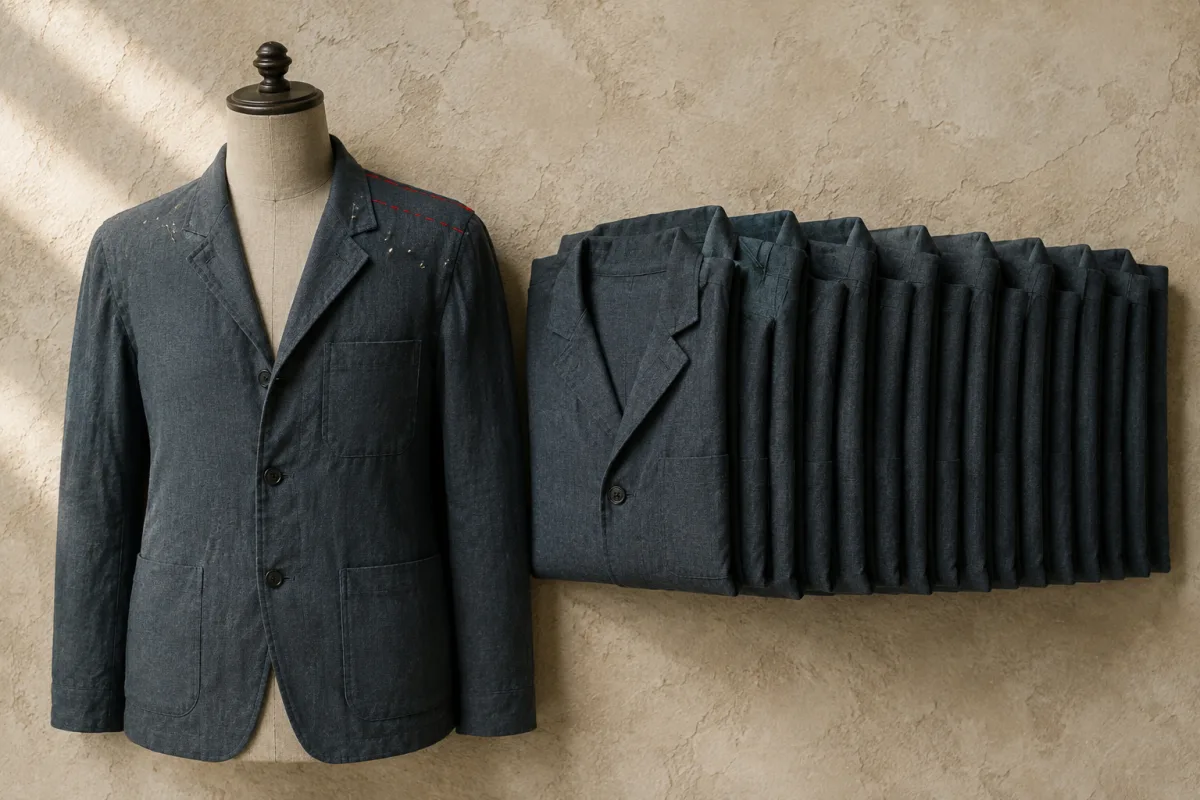
Illustration: a jacket on a form beside folded sizes. Which sizes have actually been fitted, rather than only produced?
A range approved on one body has been tested at exactly one point on its size curve and is then sold across the whole of it. Every other size in the range is an unverified derivation, and the brand finds out which of them were wrong after the customer has paid for the shipping.
## 01Grading derives a shape, it cannot confirm one
The mechanism is ordinary and easy to miss. Fit is developed and approved on a base size, worn by a person who stands for that size. Grading then extends the approved shape outward by rule, adding and subtracting at defined points to produce the rest of the set. Grading is a competent, necessary piece of work and it does what it says. What it cannot do is confirm anything. It applies a proportional assumption to a shape that was only ever proved once, and bodies stop behaving proportionally as they get further from the middle. Depth, width and posture can vary independently. [The relationship between one measurement and the next does not hold as steadily at the ends of a range as it does at the centre](https://surajmalstudio.com/guides/sizing-and-fit-for-womenswear).
Error in a derived size does not stay the size of the assumption that produced it. Each step of the grade applies its increments to the shape that came out of the step before, so a small mismatch between the rule and the way bodies actually change is carried forward and added to at every size. A step or two out from the base it is a fractionally slack armhole. At the end of the run it is a garment that reads as the wrong shape rather than the wrong size. That accumulation is why the ends of a range fail in a way that feels categorically different from the middle, and why a fault at the end is so often mistaken for a fault in the style itself.
The rules are the reason. A simple grade may distribute increments by a fixed proportion. That assumption needs testing over the offered range: body depth, width and posture do not have to change together. A width-led grade can therefore miss depth or balance that the intended customers need. More deliberate grade rules can account for this. Features placed in relation to a body, a pocket, a waist seam, a placket, a strap, are moved by the rule as though their position were purely a function of size, when in fact their position was chosen by eye on one person. A grade is a competent extrapolation. It is not evidence, and it never announces the point at which it stopped being true.
The consequence is a distribution of confidence that nobody planned. Fit evidence is strongest at the base and thins in both directions, so the sizes with the least proof behind them are the smallest and the largest. Those are frequently the ones that come back, and when they do the returns data reads as a problem with a garment, when it is a problem with where the evidence stopped.
## 02Choosing the base size decides who carries the error
Choosing the base size is therefore a real decision and not an administrative one. The useful base sits where the fit is most stable and where the derivation has the shortest distance to travel in each direction. A base taken from one end of the range makes every remaining size an extrapolation running one way, which is the arrangement most likely to fail at the far end. Where a brand knows its expected size distribution, putting the base near the weight of it means the sizes that sell hardest are the sizes closest to the evidence. A first range has no sales history to read that from, so the estimate comes out of the customer definition the brand has already written, which is one more reason for that definition to be specific.
The middle of the run is the usual answer and it is not automatically the right one. The middle is right when the expected size distribution is roughly symmetrical around it and when the fit behaves similarly in both directions, and both of those are assumptions rather than facts. Where a brand expects most of its sales towards one end, a base at the arithmetic centre puts the shortest and best proved derivation underneath the sizes that sell least. Where the fit is contested at one end, as it is in categories where the largest sizes have to absorb a proportional change the grade handles badly, moving the base towards the contested end shortens the extrapolation exactly where it is most likely to break. The base belongs where the risk is, not where the arithmetic is tidiest.
A second consideration pulls the other way and is worth naming, because it is usually the one that wins by default. The base size is also the sample size: it is what gets photographed, what goes out to anyone assessing the range, and what everybody sees. A base chosen for fit reasons and a base chosen for sampling reasons are not always the same size. When they conflict, the fit reason should win, because a sample in another size can be made separately and a grade built on the wrong base cannot be unmade once the range is in production.
## 03Where a range approved on one body fails first
Follow a range approved once and sold across a full run. A shirt is developed on the base size, fitted, adjusted twice and approved. The pattern is graded up and down, the specification goes to the maker with measurements for every size, and the maker produces exactly what the specification asks for. Every garment in the delivery measures correct against its own line on the chart. Nothing in the process has failed. Nothing in the process has been tested either.
The first failure appears at the top of the range and it is not a width failure. [The shirt measures right across the chest and sits wrong through the armhole and the upper back](https://surajmalstudio.com/guides/sizing-and-fit-for-menswear), because those are the places where depth and posture moved and the grade moved width. The customer reports it as tight, which sends the brand to look at the chest measurement, which is correct, and the investigation stops there.
The second failure appears at the bottom of the run, where the same shirt is roomy in a way that reads as sloppy rather than generous. A garment graded down keeps proportions that were drawn for a larger frame: the pocket sits low, the placket looks wide, the shoulder overhangs. The customer reports that it does not look like the photograph, and they are right, because the photograph was the base size.
The third failure is the expensive one, because it never comes back. Customers at the ends of the run who found the garment nearly right keep it and do not order again. The brand sees weak repeat orders and thin sell-through at the extremes and reads it as evidence that those sizes do not sell, so the next range is cut shorter at both ends. The run then narrows around the only size that was ever actually proved, and the narrowing is recorded internally as a demand finding rather than as a fit failure. That is how a brand ends up with [a size range that describes its fitting schedule instead of its customers](https://surajmalstudio.com/insights/2026/08/the-size-chart-is-a-brand-decision).
## 04What a size set fitting tests that a base fitting cannot
The size set fitting is the test that decides whether the grade describes people. Sewing a set across the range and putting each garment on a body of that size is the only point at which the assumption is examined instead of trusted. It is commonly treated as a formality, scheduled late, sometimes reduced to a measurement check on a table. [A garment measured flat can be entirely correct and still sit wrong, because the fault at the extremes is usually about balance and proportion, which only appear on a body](https://surajmalstudio.com/insights/2026/06/how-to-read-a-garment-sample). The extremes of the range deserve evidence in the same way the base did, and a range that cannot get that evidence is making a claim it has not tested.
Four things are visible only this way. Proportion is the first: whether the garment still looks like the same design at the ends of the run, or whether it has quietly become a heavier or meaner shape while remaining dimensionally correct. Movement is the second: whether the arm still lifts, the leg still strides and the body still sits at sizes where the grade has altered the relationship between armhole, sleeve and body. Feature placement is the third: whether pockets, waist seams, buttons and straps have landed where they were designed to land relative to a body of that size, rather than where the rule put them. The fourth is whether the grade held at all, which can only be answered by seeing the set together and judging whether it reads as one design in several sizes.
A measurement check on a table answers none of those. It confirms that the maker produced what the specification asked for, which is a supplier question worth asking, and it is routinely allowed to stand in for the fit question because it produces a table of numbers that looks like evidence. A garment can be perfectly compliant with its own specification and still sit badly on the body that specification was written for, and the discrepancy stays invisible until somebody puts it on.
## 05The fit model is a proxy for a customer
There is a harder point underneath all of this. A fit model is a proxy for a customer. The proportions that person carries become the proportions the clothes are correct on, and everything else in the range is a calculated departure from them. That means selecting a fit model answers the same question the brand answers in its casting, its price and its language: who these clothes are for. The answer is usually arrived at by availability, by whoever the pattern room works with, by which agency was easiest to book that week.
Which is a strange way to settle it. A brand that has thought carefully about its customer and then approves every garment on a body chosen for convenience has placed a stranger between its intention and its product. If the customer the brand describes has a different height, a different balance of measurements or a different posture from the person the clothes were signed off on, the range will be quietly correct for somebody else. Nothing in the process will report the discrepancy, because every garment passed its fitting.
Availability is not a disgraceful reason on its own. Sessions have to be booked, the pattern room has people it trusts and moves quickly with, and a model who can report accurately on what a garment is doing is genuinely more useful than one who cannot. The problem is not that availability is used. It is that availability is used and then never checked against the customer definition the brand wrote down. Almost nobody sets the two side by side and asks whether the person the range was approved on stands for the person it is sold to. That comparison costs nothing, takes an afternoon and is the single cheapest piece of fit work available.
One session compounds the problem further. A single fitting on a single day records one posture, one moment of a body that fluctuates, and the practised habit fit models have of standing well. Approving on that alone means signing the product on the best available reading of one person. Repeating the fitting, and seeing the base size on more than one body, is what turns a reading into a finding.
## 06Returns sorted by size are a diagnostic
Read fit returns by style, size and colour alongside the number sold, customer comments and measurements from actual garments. A concentration near the ends of a size run is a reason to inspect the grade; a problem across sizes also warrants checking the base pattern and guidance. These are leads to investigate, not diagnoses. Small samples, production variation, traffic and stock availability can produce similar patterns.
A low return rate does not prove that fit is working. Some customers keep garments that are only nearly right; others may not yet need a repeat purchase. Read return and repeat behaviour alongside direct fit feedback, and give each group enough time to respond. Neither silence nor a missing second order establishes a fit fault.
## 07The objection: a first range cannot carry a full fit programme
The objection is fair, and it is what actually decides this in practice. [Fittings consume sample fabric, pattern time, session time and calendar](https://surajmalstudio.com/guides/from-pattern-to-approved-sample), and a first range is usually being financed by a founder against a launch date that has already moved once. Telling a brand in that position that every style needs a full size set fitting is advice that will be ignored, and should be, because a range that never ships fits nobody.
The honest answer is that fit evidence should be bought where it changes decisions, and most of what matters can be had cheaply. Fit the block, not the range: styles in a range share blocks, so proving the grade on shared blocks can reduce repeated work. Changes in fabric, finish or construction still need review, and a second colourway may need additional checks if dyeing or finishing changes its behaviour. Fit the ends, not the whole set: the base has already been approved, so sewing the two extremes and looking at them beside it tests the accumulation where the accumulation happens. Use a real body rather than a booked one where the budget will not stretch, since somebody of roughly the right measurements who will stand, move on request and say what they feel is better evidence than a table, and the sample garment exists in any case. And do the free comparison first: put the measurements of the person the range was approved on next to the customer definition and see whether they describe the same body.
There is also a genuine exception. A very narrow size run, a short grade over a handful of sizes on silhouettes that carry volume rather than following the body, is a case where a single base fitting really is close to sufficient. The derivation has almost no distance to travel, the error has no room to accumulate, and a garment designed to sit away from the body forgives the proportional drift that remains. A brand launching on a short run of relaxed pieces may have less exposure to this risk, but should still confirm the offered fit and movement. It becomes exposed the moment it extends the run, adds a fitted silhouette, or moves into a category whose proportions change faster across sizes, and at that moment the fit work that was reasonable to skip becomes the first thing that should be scheduled.
None of this argues for a bigger fit programme as a matter of principle. It argues for knowing which sizes in a range are proved and which are inferred, and for keeping that distinction visible when the returns arrive. A brand can decide to offer a narrower range it has actually tested. It can decide to invest the fit work at the ends because that is where its customers are. What it should not do is carry an unexamined grade into production and then read the resulting returns as bad luck.
Fit is the one part of a clothing brand that the customer verifies personally, alone, with no help from the photography or the copy. It is worth more evidence than one body on one afternoon.
Your next step
Put this into practice for your collection.
[Talk about your idea](https://surajmalstudio.com/enquire)
## Read next
### [Can a design change after the order is placed?](https://surajmalstudio.com/guides/can-i-change-the-design-after-ordering)
A design can change after ordering, but the maker must check the work already committed, the approvals needed and the effect on cost and delivery.
### [Does a manufacturer need a tech pack before quoting?](https://surajmalstudio.com/guides/do-i-need-a-tech-pack)
A maker needs clear written instructions to quote meaningfully; unfinished choices can stay open if the quotation records its assumptions.
### [From a sketch to the first real sample](https://surajmalstudio.com/guides/from-sketch-to-first-sample)
How a drawing becomes a garment, what the first sample can prove, and which written approvals carry the clothes through to production.
### [From pattern to approved sample](https://surajmalstudio.com/guides/from-pattern-to-approved-sample)
Treat the base pattern, fit approval, grade rule, size set and production sample as one connected sequence of decisions.
Read next [Can a design change after the order is placed? 4 min read · Developing your product](https://surajmalstudio.com/guides/can-i-change-the-design-after-ordering) [Does a manufacturer need a tech pack before quoting? 5 min read · Developing your product](https://surajmalstudio.com/guides/do-i-need-a-tech-pack) [From a sketch to the first real sample 7 min read · Developing your product](https://surajmalstudio.com/guides/from-sketch-to-first-sample) [From pattern to approved sample 9 min read · Developing your product](https://surajmalstudio.com/guides/from-pattern-to-approved-sample)
---
[View this page on the website](https://surajmalstudio.com/insights/2026/09/one-fit-model-is-not-a-fit-strategy)