Against launching with everything
A launch range is an argument, not a catalogue. Every style in it has to earn the place.
On this page 4 sections
01Give the launch a clear focus
A launch range should express one clear position, not every possible future direction. Breadth at launch spreads money, attention and evidence across more products before customer response is available.
More styles can make a launch range appear complete, especially after several garments have been developed. Different occasions, weather conditions and retail positions can all be represented. A customer encounters only the finished range. The launch must make the brand's core capability legible before extending towards a complete wardrobe.
Styles using the same fabric quality and colour may combine demand against one mill minimum, quoted in metres for woven cloth or kilos for knit. Consumption is still calculated separately for every style. The garment minimum remains in units, per style and per colour.
Every style repeats pattern and grading, technical specification, sampling, testing and line setup.
- Pattern and grading
- Tech pack, BOM and points of measure
- Proto, fit, size set and PP samples
- Physical testing
- Line setup
At 4 styles the range carries 20 repeated per-style obligations against one eligible fabric order. Cutting to 2 reduces the second number to 10 and leaves the first untouched.
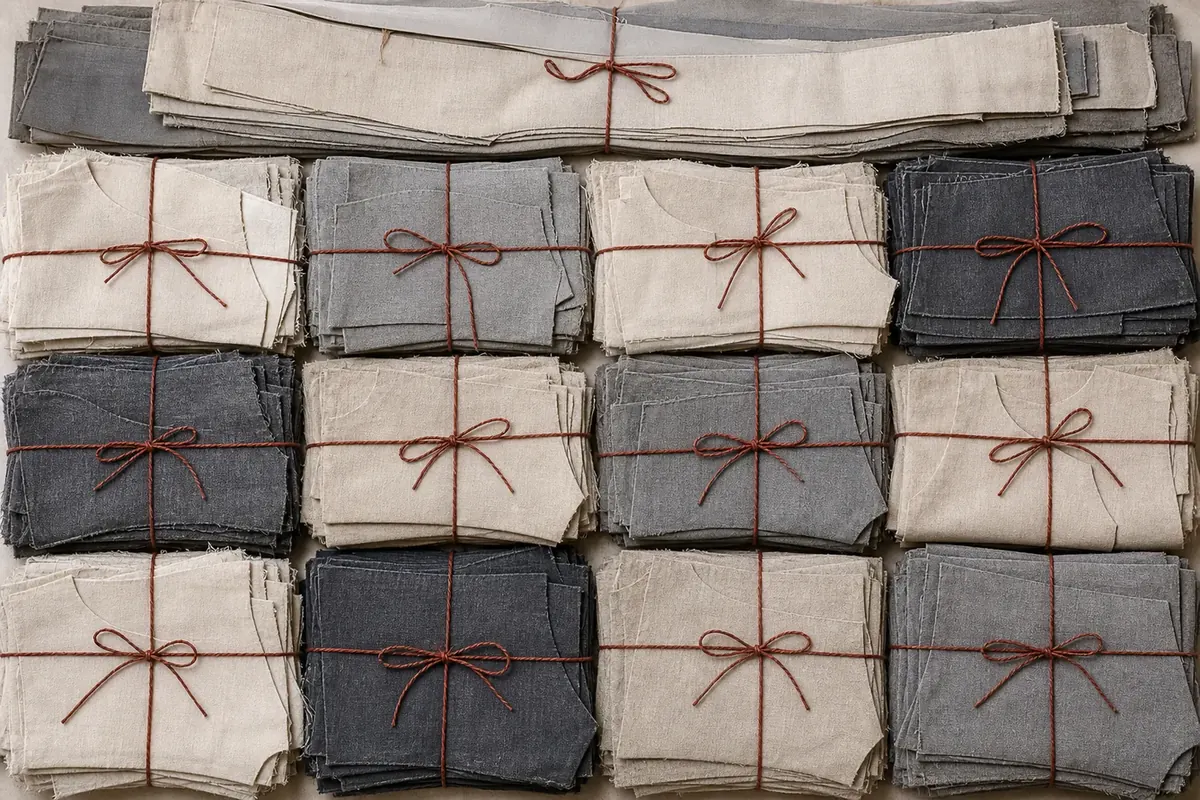
Rail length shows relative breadth, not a style count or spend.
Focused scope carries less repeated workDouble-digit range
Patterns, bills of materials, samples and approvals multiply by style. Garment commitments multiply again by colour.
Single-digit first range
Fewer styles leave room to resolve fit and construction. Garment minimums still apply per style and per colour. Mill minimums apply per colour, in metres for woven cloth or kilos for knit.
Scope comparisons 2 · explicitly single-digit options 1
02Count styles, sizes and colours together
The commercial mechanism is multiplication. Every style becomes stock-keeping units once size and colour are applied. A stock-keeping unit is the distinct inventory record for one product variation. Each colour can bring a minimum order per colour, the least production quantity accepted for that colourway. The collection may look edited at style level while the underlying stock commitment is already fragmented.
Development multiplies too. A woven shirt, jersey top, tailored trouser and outer layer may share a palette while requiring different fabric bases, patterns, construction knowledge and suppliers. Each needs a proto, the early sample used to test pattern and construction. Each needs fit approval, grading and a pre-production sample, the signed garment made with approved components before bulk. Shared colour does not make those processes one programme.
A wide range also weakens learning. If a colour sells poorly across several products, the cause may be the shade, the garment, the way it was photographed, broken size availability or an unclear product page. Thin sales across many stock-keeping units produce noise. A focused launch gives each product a defined role and makes the customer's response easier to interpret.
Communication carries the same cost. Each product needs a reason to exist, a fit explanation, material information, imagery and a place in the launch sequence. When the range is too broad, the copy falls back on minor features and repeated claims because the central proposition cannot distinguish every item. The customer sees abundance but receives little help choosing.
Wholesale does not automatically reward breadth either. A larger rail can give a buyer more options, yet it can also obscure which products are meant to define the brand and which are supporting sales. A focused offer makes the intended buy visible. Extensions become stronger when they answer demand instead of filling space in advance.
03An example: narrowing a tailoring collection
Consider a brand built around softened tailoring for daily wear. The development list expands to a blazer, trouser, skirt, dress, shirt, jersey layer, coat and several variations of each. The idea can support all of them in time. At launch, making them together introduces several cloth behaviours. The trouser needs recovery at the knee and seat. The dress depends on drape, the way fabric falls under its own weight. The coat needs enough structure to hold a larger silhouette.
Forcing one fabric across the group may create false efficiency. A cloth that gives the blazer an easy line may sag in the trouser. Choosing separate fabrics restores product quality but divides colour approvals, material commitments and quality control. Lab dips, the small dyed submissions used to approve colour, may match under one light and separate once different fibres and finishes are placed together. The visual family now requires active coordination.
04Choose what to launch and what can wait
Editing the launch does not mean choosing only the cheapest garments or the easiest ones to make. It means choosing the smallest group that proves the full proposition. The defining tailored piece may need to stay because it gives the brand authority. A compatible bottom shows the silhouette as intended. A lighter piece makes the proposition available in another wearing situation. Everything else must justify the new information it adds.
Use a range architecture before a sketch becomes a production commitment. Give each garment a role: define the brand, complete an outfit, open an accessible entry, or extend wear across conditions. Check for duplication in customer use, not just visual similarity. A skirt and trouser may look different but serve the same commercial role. Two shirts may use the same block yet communicate distinct occasions.
Then map the technical burden. Identify new patterns, fabric bases, trims, washes and colour approvals. Review CMT, the cut, make and trim portion of garment cost, where construction changes. Check whether shared cloth still gives each product the right hand feel, meaning its tactile character, and the right performance after care. Efficiency counts only when the customer does not pay for it through a compromised garment.
Hold the remaining ideas as a development queue, not a promise. Customer questions, fit feedback, repeat demand and channel response can then decide which extension deserves attention. A later product built from evidence can reuse proven blocks, colours and language with purpose. A launch product built to make the range look complete has no such advantage.
Do not launch the archive of your thinking. Launch the part sharp enough to be remembered.