The most expensive decision is not the fabric
It is not the fabric. It is the number of styles, and the reason is not obvious.
On this page 4 sections
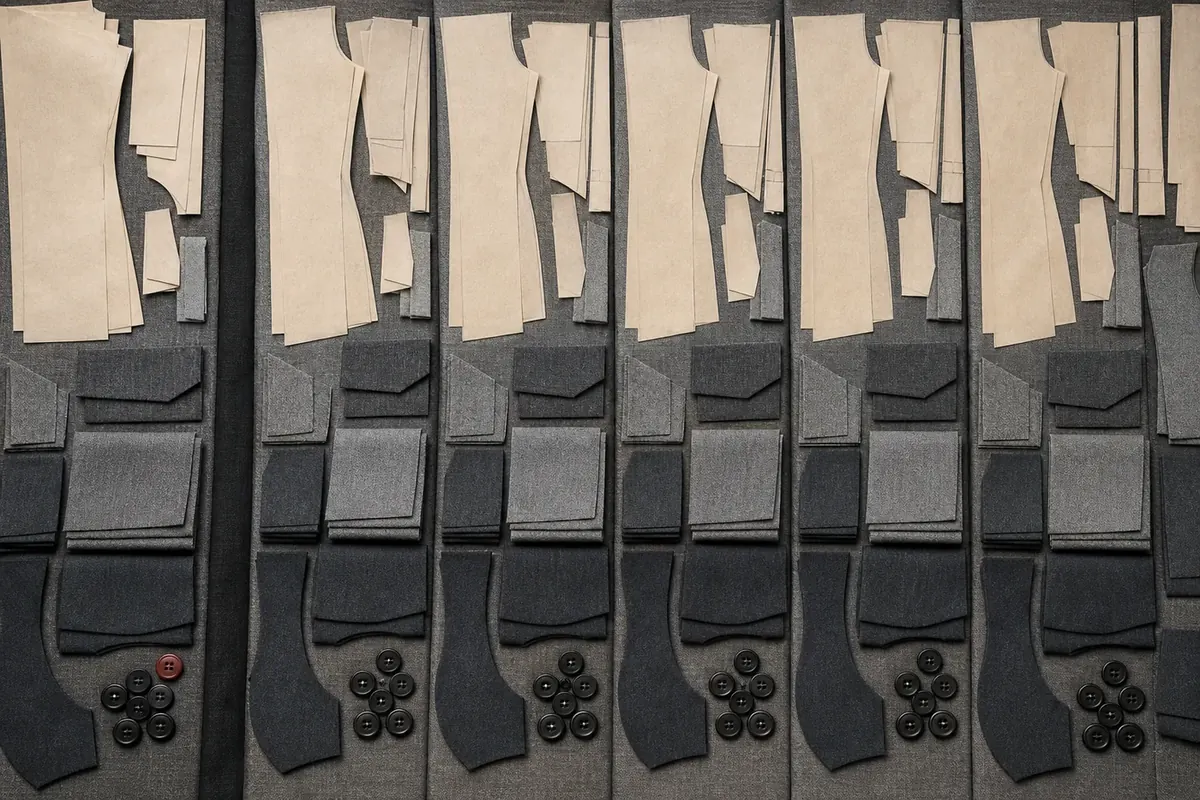
01Count the work behind each style
The most expensive early decision is the breadth of the range. Every added style creates its own chain of development, production and stock risk.
Fabric attracts scrutiny because it is visible on a costing sheet and central to the garment. Range breadth is harder to see as one cost. It arrives as separate patterns, samples, colour approvals, trims, labels, photographs, product pages and units of stock. Those obligations appear in different conversations, which obscures their combined cost. Together they are the commercial shape of the collection.
- Pattern and grading
- per style
- Lab dips
- per colour
- Dye setup
- per colour
- Screens
- per colour per placement
- Physical testing
- per style
- Colourfastness testing
- per colour
- Line setup
- per style
Three attach to the style, three recur for every colour, and screens recur for every print colour at every placement. Each uses a different applicable quantity.
At 4× the applicable quantity each one carries about 25% of the share it carries at the starting quantity. The first doubling halves that share. Further increases keep reducing it, but by smaller absolute amounts.
A mill sets its fabric minimum per colour, in metres for woven cloth or kilos for knit. One fabric quality in one colour may serve several styles when their separately calculated consumption is combined. The garment minimum remains per style and per colour; the obligations below recur for every style.
Fabric order
- Pattern
- Bill of materials
- Points of measure
- Grade rule
- Samples and approvals
- Physical testing
- Line setup
1 shared input can consolidate · 7 obligations repeat per added style
02What another style adds
A style is not just a sketch. It needs a pattern, a bill of materials and its own points of measure, the named locations used to control fit. It needs a grade rule, which tells the pattern how those measurements change across the size range. If the style comes in several colours, each colour may require a lab dip, the small dyed submission approved before fabric is committed. The minimum order per colour, meaning the least production quantity accepted for that colourway, can split a sensible total order into awkward fragments.
The asymmetry matters. Consolidating fabric can improve the efficiency of a programme because the same cloth may support related garments. Adding a style moves the other way. Even where fabric and trims are shared, the new pattern must be tested, fitted, graded, costed and controlled. CMT, the cut, make and trim portion of garment cost, changes with the operations needed for that style. Attention does not consolidate as neatly as cloth.
Breadth also creates option value for the customer while removing it from the founder. A shopper can choose among more products. The brand has already paid to make all of those choices available, before knowing which one matters. If two similar shirts divide demand, their combined performance may look healthy while each style carries slow sizes and colours. The apparent variety has converted a clear buying signal into scattered stock.
03An example: adding pieces to a launch
Consider a launch collection built around an easy woven layer. The core idea is strong enough to appear as an overshirt, a shirt dress, a cropped jacket and a longer coat, supported by trousers and jersey pieces. On a design board the family looks coherent. In development, the common idea starts to separate. The dress needs different balance and pocket placement. The cropped jacket exposes the stiffness of the cloth. The coat requires construction that shifts its CMT. The trousers need their own fit logic and grade.
Colour multiplies the issue. A dark neutral may work across every garment, while a pale shade becomes translucent in the trouser and too flat in the coat. The same dye lot, a batch of fabric dyed together, does not solve category-specific behaviour. Linings, interlinings, fastenings and labels still need to be chosen. A material story that looked efficient can become several technical programmes connected mainly by a name.
04Decide what belongs in the first collection
The decision is not whether those products are good ideas. It is whether they deserve to become inventory at the same moment. Put each style through a burden test. What new customer use does it add? Which material or construction route does it introduce? Does it clarify the brand or repeat a point already made? What must be developed, photographed, described and replenished solely because this style exists?
Sampling capacity is part of that burden. When many styles develop together, comments compete for attention and linked decisions fall out of sequence. A fabric change approved for one garment may never reach its companion. A pocket revised on the proto, the early sample used to test pattern and construction, may remain old in the measurement sheet. The problem is not only workload. It is loss of configuration control across a widening set of files, samples and approvals.
The stock risk continues after launch. Replenishment depends on knowing which product, size and colour deserves another commitment. A wide initial buy can leave strong products unavailable while weaker ones still occupy cash and space. Breadth has then reduced the brand's ability to back the evidence it worked hard to obtain.
Then build the range around roles. A defining product carries the proposition. Supporting pieces make it wearable. A commercial entry point can widen access without opening a separate design language. Shared fabric, trims and blocks should be intentional, provided they suit the garment. A shared block is a proven pattern foundation, not permission to force different products into the same proportions.
Cost the range as a system before polishing individual sketches. Include development work, colour commitments, content and stock exposure in the discussion. Ask what happens if one style is removed. If the collection becomes clearer and little customer use is lost, the style was consuming resources without carrying an argument.
A range looks serious when every product has a job, not when every idea has a purchase order.