What a supplier actually hears when you send a brief
The same brief reads differently on the other side of the table. Here is how.
On this page 4 sections

01Turn a description into making instructions
A founder writes a brief to express intent; a supplier reads it to decide what to quote, source and make. Any gap between those purposes becomes an assumption, and assumptions enter the garment as real decisions.
“Soft, premium cotton” sounds descriptive from the brand side. From the supply side it leaves open the fibre, yarn, fabric construction, gsm, finish and price bracket. Gsm means grams per square metre and records fabric weight, but even that does not settle softness. Hand feel, the tactile character of the cloth, is affected by fibre, yarn, structure, dyeing, finishing and wash. The supplier must choose which version of the adjective you meant.
Each open phrase leaves a production decision unresolved.
- “Good quality cotton”
- Leaves openFibre content, yarn, weight, finish and tolerance remain unspecified
- “A nice mid weight”
- Leaves openTarget fabric weight and its acceptable tolerance remain open
- “Similar to this one”
- Leaves openOnly named, measurable properties can be matched consistently
- “Standard packaging”
- Leaves openThe supplier's default fold, bag, carton and labelling method applies
- “The usual trims”
- Leaves openComposition, finish, dimensions and approved references remain open
- “Match this colour”
- Leaves openA colour reference, lab dip approval and viewing condition are still needed
Open phrases 6 · production decisions delegated 6
02Make the quote assumptions visible
This is not a failure of care. A quotation cannot be built from atmosphere alone; our specification guide sets out the decisions a supplier needs. Material consumption, CMT, trims and finishing need defined assumptions. CMT is the cut, make and trim part of garment cost, shaped by the operations required to assemble the style. If the brief leaves seam finish, fastening type or pocket construction open, the quote has to include some version of them. That version can become the default without being recorded as a decision.
Silence behaves in the same way. A blank field is rarely read as a generous invitation to design. It is read as unresolved, and work cannot wait for every unresolved point indefinitely. Someone selects a standard option, follows the reference sample, or uses the most available construction. The result may be perfectly competent and still miss the reason the garment exists.
Brand intent, product criteria and production instructions operate at different levels. Brand language should describe the customer effect: dry instead of silky, relaxed without looking oversized, substantial enough to wear alone. Product development turns that intent into testable criteria. A tech pack, the production file of drawings, measurements, construction notes and materials, turns the criteria into instructions. Each level has a job. Problems arise when an adjective is placed where a production decision should be.
Quotations should preserve their assumptions. If an exact fabric has not been nominated, the proposed quality should be named clearly enough to compare later. If a wash remains open, its treatment and likely effect should not disappear into a general finishing line. The founder can then see whether two prices describe the same garment or merely use the same sketch.
03An example: briefing a washed overshirt
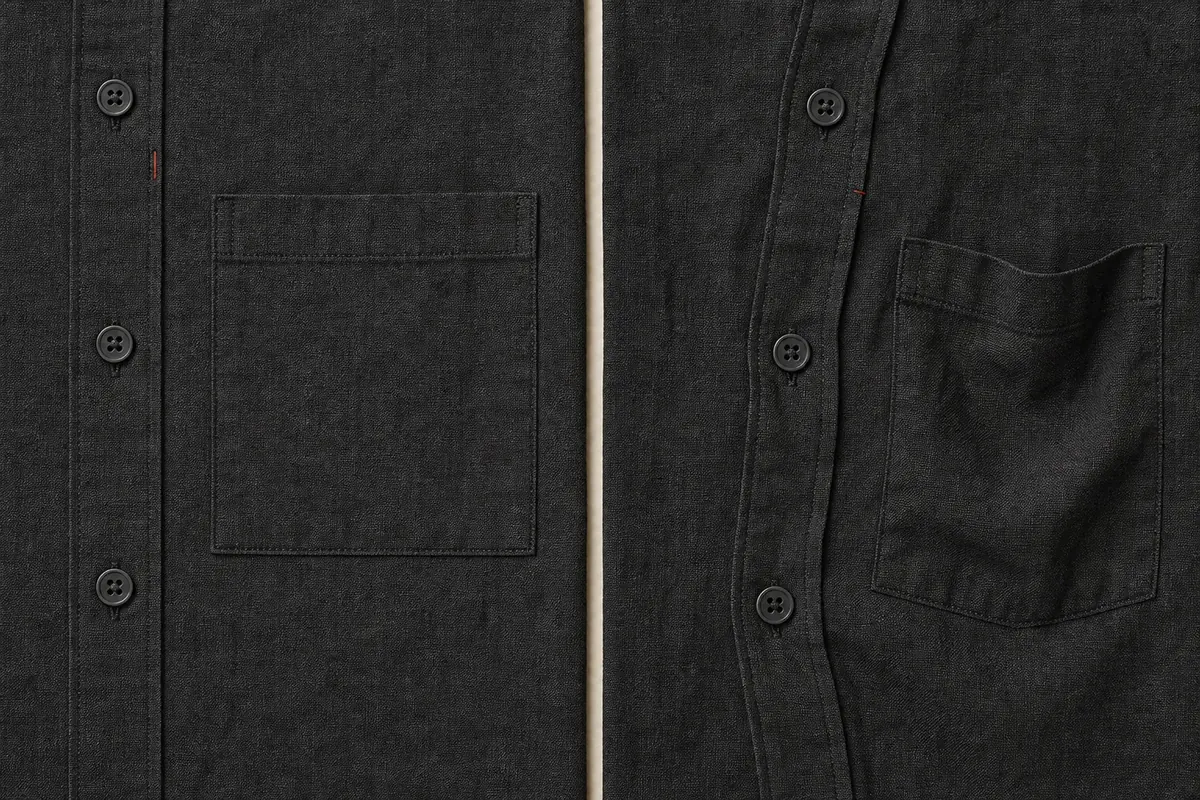
Consider the brief “washed black overshirt, soft premium feel, relaxed fit, tonal hardware”. A supplier has to resolve what “washed” means, whether black should look saturated or faded, how much ease creates “relaxed”, and which components count as hardware. The image reference may show a heavy jacket, while the intended retail position supports a lighter shirt construction. A quote returned against one interpretation cannot be compared cleanly with a quote based on another.
A development-ready version separates intent from instruction. The overshirt should feel broken in but retain a clean collar. The fabric proposal should sit within an agreed composition and weight bracket, then be approved against a physical hand-feel reference. Drape, meaning how the cloth falls under its own weight, should support the intended body volume. The black should be reviewed through a lab dip, a small dyed submission, and the expected wash effect should be shown on the relevant fabric.
Fit needs the same translation. “Relaxed” becomes a set of relationships between body and garment, recorded through points of measure. These are named measurement locations such as chest, shoulder and body length. The target measurements need tolerances, which define acceptable variation. The grade rule then states how the measurements change across sizes so the idea does not become progressively tighter or looser at the ends of the range.
Reference samples help, but only when their role is named. One sample may be a standard for fit, another for fabric hand, and another for wash. Asking a supplier to copy “this” without saying which quality matters invites them to copy the most obvious feature. References also contain unrelated decisions: fibre composition, seam allowance, trim weight and proportions belong to somebody else's commercial model.
04Separate fixed choices from open questions
Build an ambiguity register before enquiry. Read every adjective and ask what decision it hides. Mark each field as fixed, proposed or open. Fixed means quote and sample to the instruction. Proposed means the supplier may offer a technically suitable alternative for review. Open means a recommendation is wanted, with the effect on cost, minimum order per colour, meaning the least production quantity accepted for that colourway, and material behaviour made clear before approval.
Then establish an order of precedence. If the drawing conflicts with the measurement table, which one governs? If the approved swatch and written gsm differ, stop and reconcile them. If a proto, the early sample used to test pattern and construction, changes during fitting, update the file instead of relying on the marked garment alone. The pre-production sample, the signed standard made with approved components before bulk, should close decisions, not conceal contradictions.
A good brief does not remove dialogue. It makes the dialogue occur before an assumption is cut into cloth.