What fifty-eight years changes about how we design
What longevity actually buys you, and what it does not.
On this page 4 sections
01How manufacturing experience helps
Experience matters when it changes a decision before that decision becomes expensive. Surajmal Shobhachand was established in 1968, and the useful result is earlier recognition of where a garment programme is likely to fail.
Longevity on its own proves little about the quality of a new idea. Its value lies in pattern recognition across design, development, sampling, lab testing, quality control and production running through an audited network. The same categories of risk recur in different clothes: a fabric changes after washing, a pale dye exposes a seam allowance, a trim pulls against a light cloth, or a grade makes the largest size look like a scaled drawing instead of the same garment.
Costing enters at first factory costing in a sequential handover and during design in integrated development.
Sequential handover
- 01Brief
- 02Design
- 03Specification handed over
- 04First factory costing · costing enters
Integrated development
- 01Brief
- 02Design and costed together · costing enters
- 03Specified
- 04Sampled
2 models · 4 stages each · costing moves 2 stages earlier
02Ask the practical questions earlier
Experience becomes useful when memory changes sequence. A process without it can know that shrinkage, shade and fit matter and still reach them after a sample has exposed the problem. A mature process places the questions before the dependent decision. If a cloth will be washed, expected dimensional change is established before the pattern is finalised. If colour is critical, a lab dip, the small dyed submission used for approval, is reviewed in the intended fibre and finish before bulk.
This does not remove uncertainty. Textiles are variable materials. A dye lot, meaning a batch dyed together under the same conditions, can differ from another lot. Finishing can change hand feel, the tactile character of the cloth, as well as measurement. Sewing joins materials under tension, so the same pattern may behave differently in a compact poplin and a fluid twill. Experience makes those variables visible while choices remain open.
03An example: developing a washed overshirt
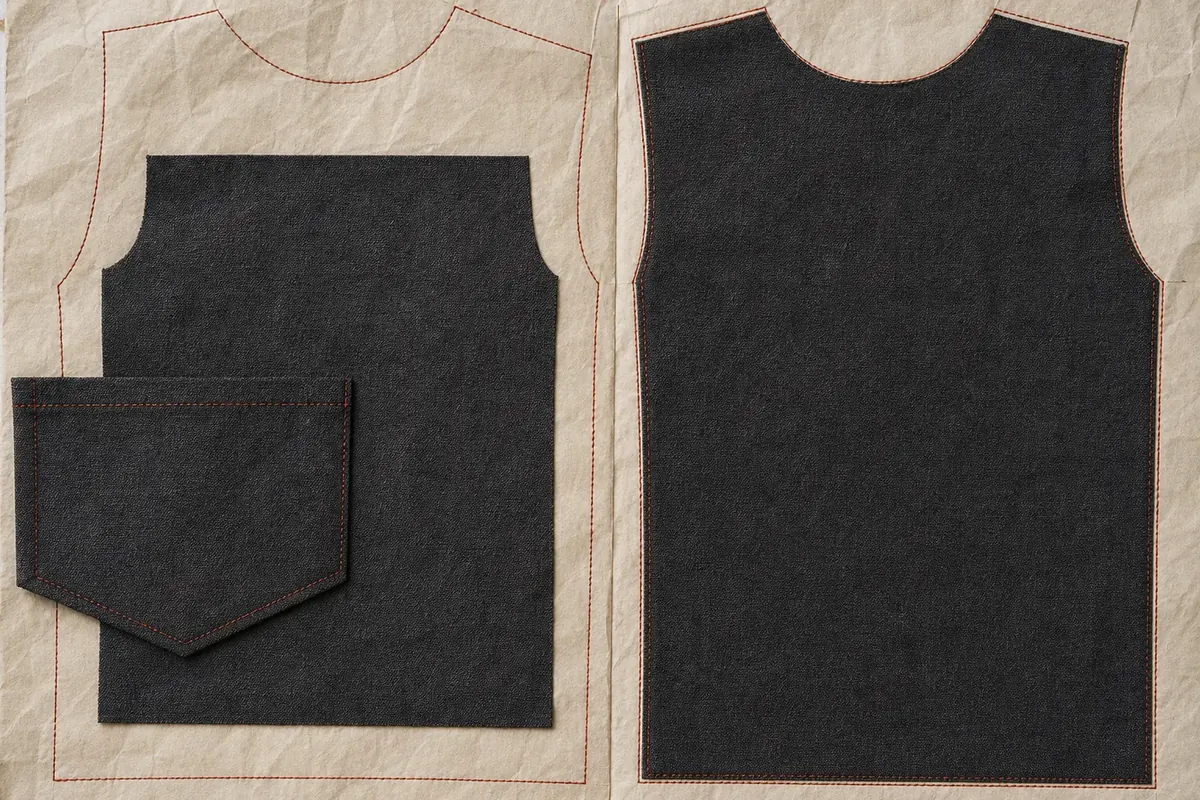
Consider a washed cotton overshirt. The design depends on a relaxed body, a clean collar and a dry, softened surface. The drawing is straightforward. The technical questions are connected. Washing may reduce length and width, so the pattern needs a shrinkage allowance, the provision that lets the finished garment return to its target measurements. The collar components must shrink compatibly or the edge may distort. Pocket placement has to be judged after wash, not only on the unwashed shell.
Shade creates another chain. The shell fabric, sewing thread, labels and buttons may respond differently to the intended colour. A lab dip can settle the fabric shade, but it cannot prove that every component will read as one colour after washing. Colour fastness, the ability of colour to resist fading or transferring under specified conditions, must suit the product's use and finish. A dark garment that looks rich before wash can become flat, streaked or mismatched if those decisions are separated.
Costing belongs inside the same chain. CMT, the cut, make and trim component of garment cost, is affected by the construction needed to achieve the design. A collar that requires more control, a pocket that must be matched to a stripe, or a seam finish chosen for a clean interior all add operations. If the cost question comes after the garment has been approved visually, changing construction can disturb the very proportion and hand that earned approval.
04Keep useful approval records
The advantage is therefore timing, not certainty. Design and cost can be examined together. A proto, the early sample used to test pattern and construction, can focus on the risks already identified. Points of measure, the named locations at which the garment is checked, can be chosen to control the intended silhouette instead of recording dimensions that happen to be easy to take.
The same principle governs approval. A tolerance states the permitted variation around a target measurement. It should reflect what the product can absorb without changing fit or function, as well as what production can control. An undemanding tolerance may be easy to meet but fail to protect the silhouette. An arbitrary tightness creates rejection without improving what the customer feels. Judgement sits between those errors.
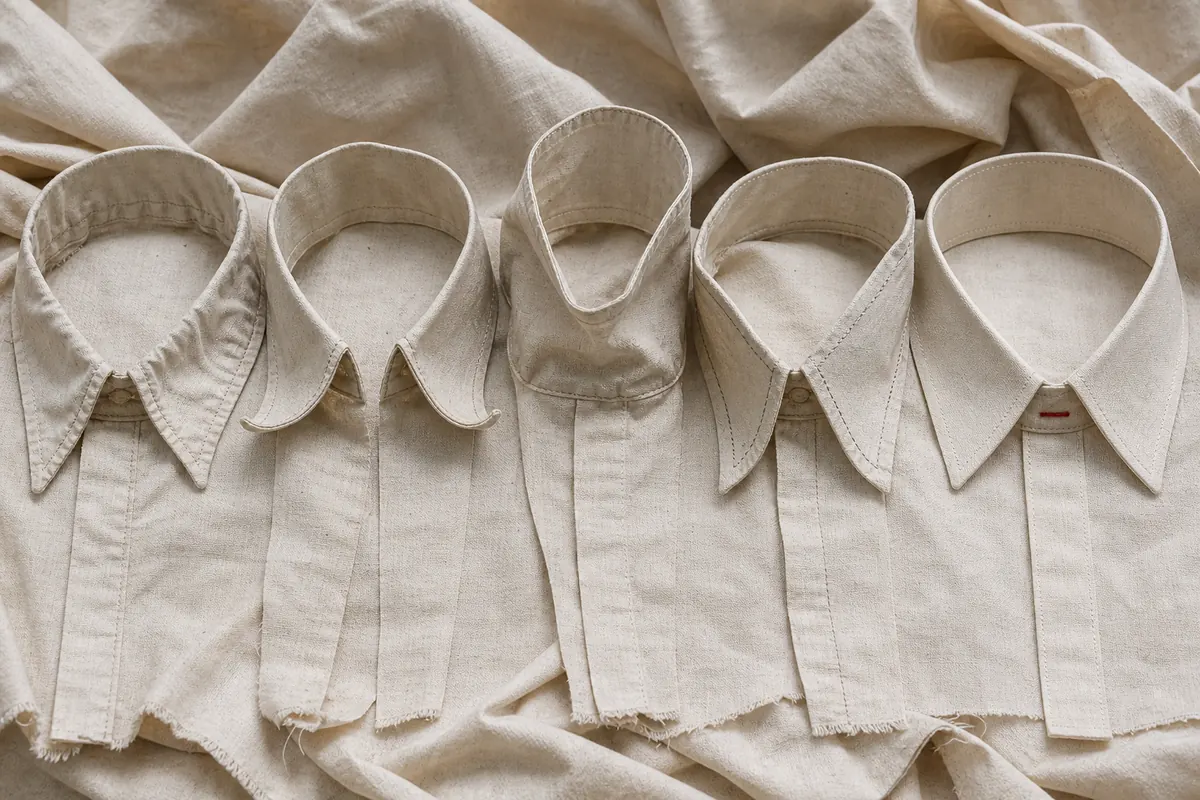
Records make that judgement transferable. A comment such as “collar approved” says little if several collar patterns, interlinings and wash states have been in circulation. Versioned specifications, dated approvals and retained physical standards connect the decision to the object that earned it. That discipline is quiet when everything goes well. When something changes, it shows exactly which assumption needs to be reopened.
Experience also recognises when a familiar solution does not belong. A heavier fusible may stabilise one collar and deaden another. A generous tolerance may be harmless in a loose jersey body and visible at a tailored waistband. Precedent is useful as a question set, never as an instruction to copy yesterday's answer.
For a founder, the practical response is to bring manufacturing questions into concept review. Ask what material behaviour the design assumes. Identify which detail is most sensitive to cost, wash, shade or operator handling. Decide what the proto must prove. Keep approvals tied to physical standards: the accepted swatch, lab dip, fit record and pre-production sample, which is the signed garment setting the expectation for bulk.
Heritage is useful only when it reaches forward and stops the next avoidable mistake.